The automotive industry is undergoing a profound transformation with the integration of Artificial Intelligence (AI) across various vehicle systems and manufacturing processes. AI technologies are enabling automakers to develop smarter, safer, and more efficient vehicles while enhancing the overall driving experience. From advanced driver-assistance systems (ADAS) and autonomous driving to predictive maintenance and intelligent manufacturing, AI is becoming a critical component of the modern automotive ecosystem. As consumer demand for connected and intelligent vehicles continues to grow, the AI in automotive market is witnessing significant expansion worldwide.
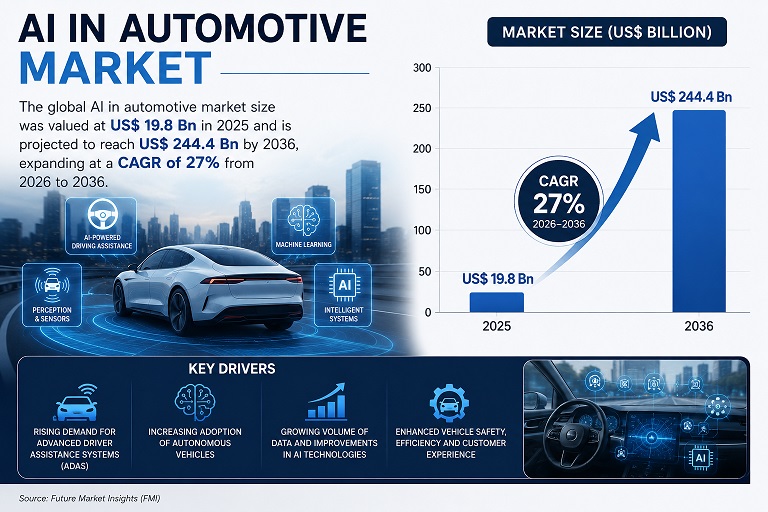
The global AI in Automotive Market was valued at approximately USD 19.8 billion in 2025 and is projected to reach USD 244.4 billion by 2036, expanding at a CAGR of 27% during the forecast period. The market growth is driven by the increasing adoption of autonomous vehicles, advanced driver-assistance systems (ADAS), connected car technologies, and AI-powered predictive maintenance solutions. Rising investments in smart mobility, electric vehicles, and intelligent transportation infrastructure are further accelerating the deployment of artificial intelligence across the automotive value chain.
Access the Sample Copy – Dive Into Data-Driven Insights: https://www.transparencymarketresearch.com/sample/sample.php?flag=S&rep_id=86930
Key Players:
- Oracle
- Qualcomm Technologies, Inc.
- Salesforce, Inc.
- Microsoft
- NVIDIA Corporation
- Amazon Web Services, Inc.
- IBM
- Intel Corporation
- Aptiv
- Mobileye
- Robert Bosch GmbH
- Tesla
- Ford Motor Company
- TOYOTA MOTOR CORPORATION
- Waymo LLC
- Other Prominent Players
The growing popularity of electric vehicles, autonomous vehicles, and connected car technologies has accelerated the adoption of AI solutions. Automotive companies are investing heavily in AI-driven innovations to gain a competitive advantage and meet evolving consumer expectations. As regulatory authorities continue to emphasize road safety and emissions reduction, AI-powered automotive technologies are expected to play a pivotal role in shaping the future of mobility.
Key Market Drivers
Rising Demand for Autonomous Vehicles
The growing interest in self-driving vehicles is one of the primary drivers of the AI in automotive market. AI enables autonomous systems to process real-time data from cameras, radar, LiDAR, and other sensors, allowing vehicles to make informed driving decisions. Automotive manufacturers and technology firms are continuously developing advanced AI algorithms to improve autonomous driving capabilities and enhance road safety.
Increasing Adoption of Advanced Driver Assistance Systems
ADAS technologies such as lane departure warning, adaptive cruise control, automatic emergency braking, and parking assistance rely heavily on AI-powered data processing and decision-making. As consumers prioritize vehicle safety, the adoption of AI-enabled ADAS solutions continues to increase across both premium and mass-market vehicle segments.
Growth of Connected Vehicles
Connected vehicles generate vast amounts of data that can be analyzed using AI technologies to improve vehicle performance, navigation, maintenance, and customer experience. AI-driven connectivity solutions enable real-time communication between vehicles, infrastructure, and cloud platforms, supporting the development of smart transportation systems.
Enhanced Manufacturing Efficiency
Automotive manufacturers are increasingly incorporating AI into production facilities to optimize manufacturing operations. AI-powered robots, predictive maintenance systems, and quality control solutions help improve productivity, reduce downtime, and minimize operational costs. Smart factories equipped with AI technologies are becoming a major trend across the automotive sector.
Market Challenges
High Development Costs
The implementation of AI technologies in vehicles requires substantial investments in hardware, software, research, and testing. Developing reliable AI systems for autonomous driving and vehicle safety applications involves significant costs, which may limit adoption among smaller automotive manufacturers.
Data Privacy and Cybersecurity Concerns
Connected and AI-enabled vehicles collect and process large amounts of sensitive data. Ensuring data security and protecting vehicle systems from cyber threats remain significant challenges for automakers and technology providers. Compliance with evolving data privacy regulations further adds complexity to AI deployment.
Buy this Premium Research Report: https://www.transparencymarketresearch.com/checkout.php?rep_id=86930<ype=S
Regulatory and Ethical Issues
Autonomous driving technologies face regulatory uncertainties in many countries. Establishing safety standards, liability frameworks, and ethical guidelines for AI decision-making remains a critical challenge for industry stakeholders and policymakers.
Regional Analysis
North America
North America remains a leading market for AI in automotive applications, supported by strong investments in autonomous vehicle development, advanced technology infrastructure, and the presence of major automotive and technology companies. The region continues to witness significant innovation in connected vehicle and self-driving technologies.
Europe
Europe is a major contributor to market growth, driven by stringent vehicle safety regulations and increasing investments in electric and autonomous vehicles. Automotive manufacturers across the region are actively integrating AI solutions to enhance vehicle performance and comply with evolving regulatory requirements.
Asia Pacific
Asia Pacific is expected to experience the fastest growth in the AI in automotive market. Rapid urbanization, rising vehicle production, growing adoption of electric vehicles, and strong government support for smart mobility initiatives are driving market expansion. Countries such as China, Japan, South Korea, and India are emerging as key hubs for automotive AI innovation.
Latin America and Middle East & Africa
These regions are gradually adopting AI-enabled automotive technologies as vehicle connectivity improves and automotive investments increase. Growing awareness of road safety and transportation efficiency is expected to support future market growth.
Emerging Trends
Several notable trends are shaping the future of the AI in automotive market:
Development of Level 4 and Level 5 autonomous vehicles.
Increasing integration of AI-powered voice assistants and virtual copilots.
Expansion of predictive maintenance solutions using real-time vehicle data.
Adoption of generative AI for vehicle design and engineering.
Growth of AI-powered fleet management and logistics optimization.
Rising use of AI chips and edge computing technologies in vehicles.
Integration of AI with electric vehicle battery management systems.
These innovations are expected to create new opportunities for automakers, technology providers, and mobility service companies.
Future Outlook
The future of the AI in automotive market appears highly promising as the automotive industry accelerates its transition toward intelligent, connected, and autonomous mobility. Growing investments in AI research, increasing consumer demand for advanced vehicle features, and supportive government initiatives are expected to fuel long-term market expansion.
As AI technologies continue to mature, vehicles will become increasingly capable of autonomous decision-making, predictive maintenance, and personalized user experiences. The convergence of AI, electric vehicles, connectivity, and smart transportation infrastructure will redefine the automotive landscape and create substantial opportunities for industry stakeholders in the coming years.
More Trending Reports by Transparency Market Research –
Pickup Truck Market – https://www.transparencymarketresearch.com/pickup-truck-market.html
Rubber Track Market – https://www.transparencymarketresearch.com/rubber-track-market.html