The global automotive industry is undergoing a transformational shift toward electrification, digitalization, and intelligent mobility. At the center of this evolution lies automotive power electronics, a critical technology that enables efficient energy management, power conversion, and vehicle control. Automotive power electronics are widely used in electric vehicles (EVs), hybrid electric vehicles (HEVs), advanced driver-assistance systems (ADAS), battery management systems, infotainment units, and charging infrastructure.
With governments worldwide implementing stringent emission regulations and consumers increasingly preferring eco-friendly transportation solutions, demand for advanced automotive electronics has accelerated significantly. Power electronics technologies, including inverters, converters, onboard chargers, and semiconductor devices, are becoming indispensable components in modern vehicles. These systems improve energy efficiency, vehicle performance, safety, and overall driving experience.
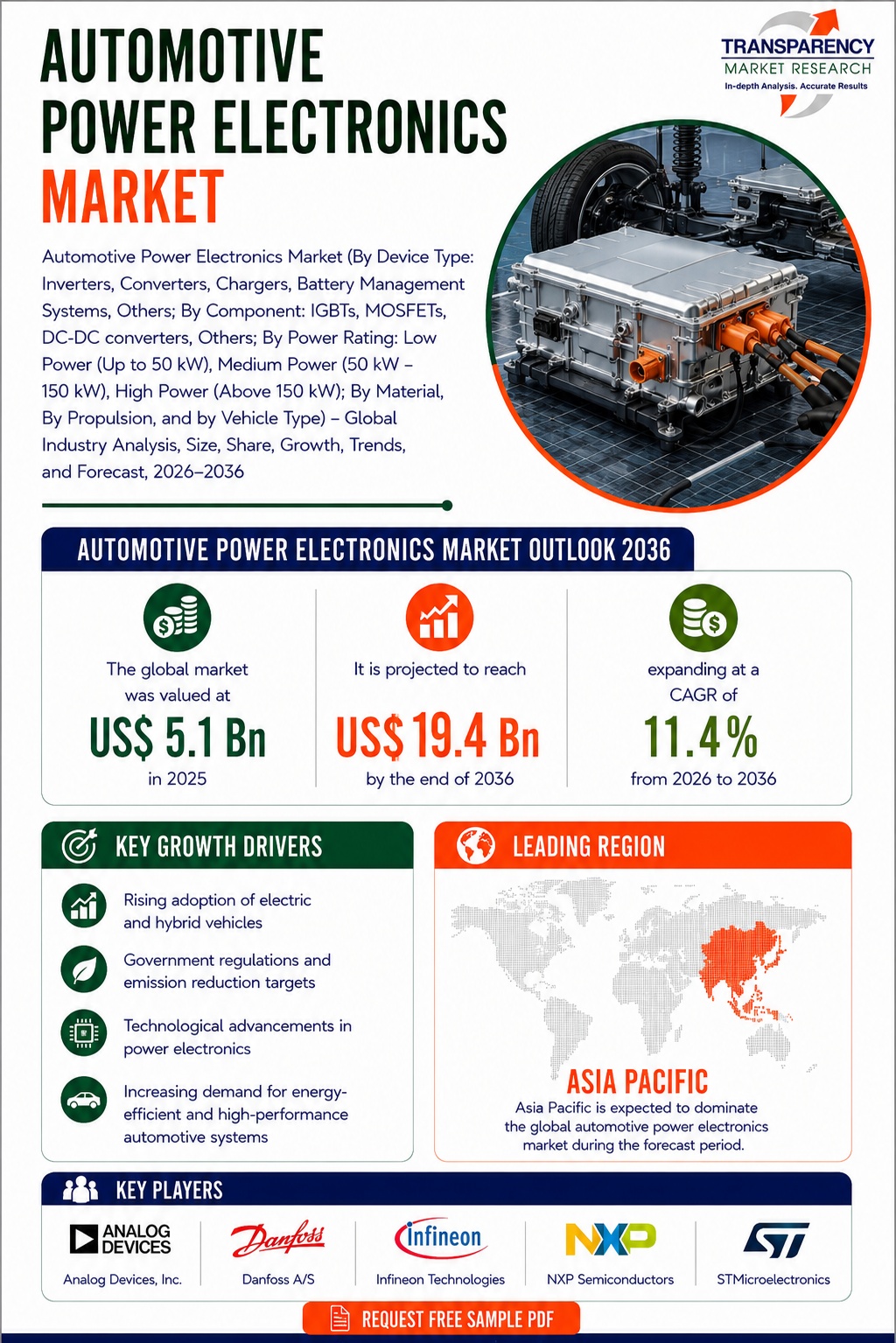
The global Automotive Power Electronics Market was valued at US$ 5.1 Bn in 2025 and is projected to reach US$ 19.4 Bn by 2036, expanding at a CAGR of 11.4% from 2026 to 2036. The market’s rapid growth is driven by increasing adoption of electric mobility, advancements in semiconductor technologies, and rising investments in intelligent automotive systems.
Gain a preview of important insights from our Report in this sample – https://www.transparencymarketresearch.com/sample/sample.php?flag=S&rep_id=34853
Market Overview: Automotive power electronics refer to electronic systems and components that control and convert electrical energy within vehicles. These technologies are essential for ensuring optimal energy utilization in electric and hybrid vehicles while also supporting advanced vehicle functionalities.
Power electronics components are extensively used in:
- Electric powertrains
- Battery management systems
- DC-DC converters
- Inverters
- Onboard charging systems
- Infotainment systems
- ADAS and autonomous driving technologies
The growing demand for electric vehicles worldwide is significantly contributing to the market expansion. Automakers are increasingly integrating advanced power semiconductor materials such as Silicon Carbide (SiC) and Gallium Nitride (GaN) to improve efficiency, reduce power losses, and enhance thermal performance.
Asia Pacific dominated the market in 2025, accounting for 45% of global revenue share, supported by strong automotive manufacturing capabilities, rapid EV adoption, and extensive government support for clean mobility initiatives.
Passenger vehicles emerged as the leading segment, holding nearly 78% market share in 2025 due to rising consumer demand for connected, energy-efficient, and technologically advanced vehicles.
Key Drivers of Market Growth
Rapid Adoption of Electric and Hybrid Vehicles
The increasing adoption of electric and hybrid vehicles is one of the primary growth drivers for the automotive power electronics market. Governments across the globe are introducing favorable policies, tax incentives, and emission regulations to accelerate the transition from conventional internal combustion engine vehicles to electric mobility.
Electric vehicles rely heavily on advanced power electronics for efficient battery charging, power conversion, and energy distribution. Components such as inverters, converters, and onboard chargers play a crucial role in vehicle operation and performance optimization.
Improved charging infrastructure, declining battery costs, and growing consumer awareness regarding sustainable transportation are further boosting EV adoption and, consequently, the demand for automotive power electronics.
Advancements in Semiconductor Technology
Technological advancements in semiconductor materials are transforming automotive power electronics systems. Traditional silicon-based semiconductors are increasingly being replaced by wide-bandgap materials such as Silicon Carbide (SiC) and Gallium Nitride (GaN).
These next-generation semiconductors offer:
- Higher efficiency
- Faster switching speeds
- Improved thermal management
- Reduced energy losses
- Smaller and lighter system designs
Such benefits are particularly important for electric vehicles, where maximizing energy efficiency and driving range are critical priorities.
Growth in Advanced Driver-Assistance Systems (ADAS)
The increasing integration of ADAS technologies is creating substantial demand for power electronics solutions. Features such as adaptive cruise control, automatic emergency braking, lane departure warning, and parking assistance require advanced electronic control units and efficient power management systems.
As autonomous vehicle technologies continue to evolve, the need for high-performance automotive electronics and semiconductor devices is expected to increase significantly.
Government Regulations and Sustainability Initiatives
Governments worldwide are implementing stricter vehicle emission standards and sustainability regulations. These initiatives are encouraging automotive manufacturers to invest heavily in electrification technologies and energy-efficient vehicle systems.
Incentives for EV adoption, investments in charging infrastructure, and support for semiconductor manufacturing are collectively contributing to market growth.
Key Players and Industry Leaders
The automotive power electronics market is highly competitive and characterized by continuous technological innovation, strategic collaborations, and product development activities.
Leading companies operating in the market include:
- Infineon Technologies AG
- Robert Bosch GmbH
- Continental AG
- STMicroelectronics
- ON Semiconductor
- Analog Devices, Inc.
- Danfoss A/S
- NXP Semiconductors
- Texas Instruments
- Renesas Electronics
- ROHM Semiconductor
- Mitsubishi Electric Corporation
- Toshiba Corporation
- Denso Corporation
- Wolfspeed, Inc.
- ZF Friedrichshafen AG
These companies are investing heavily in research and development activities focused on high-efficiency semiconductor technologies, next-generation power modules, and intelligent energy management systems.
Strategic partnerships between semiconductor manufacturers, automotive OEMs, and technology providers are also becoming increasingly common to accelerate innovation and market expansion.
Recent Developments
Several recent developments highlight the rapid pace of innovation in the automotive power electronics market.
Dow Introduced Advanced Silicone Gel
In September 2025, Dow launched DOWSIL EG-4175 Silicone Gel designed for high-temperature EV power electronics applications. The material enhances thermal resistance, vibration absorption, and reliability for high-voltage systems.
Wolfspeed Expanded Silicon Carbide Portfolio
Wolfspeed introduced its 200mm Silicon Carbide materials portfolio to support large-scale production of high-efficiency EV components. This development is expected to accelerate the industry transition toward SiC-based technologies.
Vishay Launched New MOSFET Power Modules
Vishay Intertechnology introduced advanced 1200 V MOSFET power modules featuring Silicon Carbide technology for automotive and industrial applications, improving efficiency and system reliability.
ABB Acquired BrightLoop
ABB announced its acquisition of BrightLoop, a French power electronics specialist, to strengthen its electrification offerings in automotive and industrial mobility applications.
Key Trends for the Future
Transition Toward Wide-Bandgap Semiconductors
The shift toward Silicon Carbide and Gallium Nitride technologies will continue to reshape the automotive electronics industry. These materials provide higher efficiency and support compact, lightweight vehicle designs.
Increasing Vehicle Electrification
Automotive manufacturers are accelerating their transition toward fully electric product portfolios. This trend will significantly increase demand for advanced inverters, converters, and battery management systems.
Integration of Smart and Connected Technologies
Connected vehicles equipped with AI-driven systems, cloud connectivity, and autonomous capabilities require sophisticated electronic architectures and efficient power management solutions.
Rise of Fast-Charging Infrastructure
The expansion of ultra-fast EV charging infrastructure is driving innovation in onboard charging systems and high-voltage power electronics technologies.
Buy this Premium Research Report for a comprehensive view of market dynamics – https://www.transparencymarketresearch.com/checkout.php?rep_id=34853<ype=S
New Opportunities and Challenges
Opportunities
Autonomous Vehicles
The development of autonomous vehicles presents substantial opportunities for power electronics manufacturers. Autonomous systems require powerful computing platforms, sensors, LiDAR systems, and reliable power management solutions.
Emerging Markets
Developing economies are witnessing rapid urbanization, rising disposable incomes, and increasing demand for electric mobility solutions. These markets offer significant growth opportunities for automotive electronics providers.
Energy-Efficient Mobility Solutions
Growing focus on sustainability and fuel efficiency is creating opportunities for advanced semiconductor technologies and intelligent power management systems.
Challenges
Semiconductor Supply Chain Constraints
Global semiconductor shortages continue to impact automotive production and create supply chain uncertainties.
High Initial Costs
Advanced power electronics technologies and wide-bandgap semiconductors remain relatively expensive, limiting adoption in cost-sensitive markets.
Thermal Management Complexities
As power density increases in EV systems, effective thermal management becomes increasingly important and technically challenging.
Market Trends & Innovations
The automotive power electronics industry is witnessing continuous innovation driven by advancements in materials science, digital technologies, and electrification strategies.
AI-Driven Power Management
Artificial intelligence and machine learning technologies are increasingly being integrated into automotive systems to optimize energy consumption and improve battery efficiency.
Compact and Lightweight Designs
Manufacturers are focusing on reducing component size and weight to enhance vehicle efficiency and driving range.
Future Outlook
The future of the automotive power electronics market remains highly promising as global transportation systems continue to transition toward electrification and intelligent mobility.
The market is projected to grow from US$ 5.1 Bn in 2025 to US$ 19.4 Bn by 2036, reflecting strong long-term growth potential. Technological advancements in semiconductor materials, expanding EV production, and increasing investments in autonomous driving technologies will continue to drive industry expansion.
Asia Pacific is expected to maintain its leadership position due to strong automotive manufacturing capabilities, rising EV adoption, and government support for sustainable transportation initiatives.
The increasing demand for energy-efficient, connected, and autonomous vehicles will further accelerate the adoption of advanced automotive power electronics solutions worldwide.
Market Segmentation
By Device Type
- Inverters
- Converters
- Chargers
- Battery Management Systems
- Others
By Component
- IGBTs
- MOSFETs
- DC-DC Converters
- Others
By Power Rating
- Low Power (Up to 50 kW)
- Medium Power (50 kW – 150 kW)
- High Power (Above 150 kW)
By Propulsion
- Internal Combustion Engine (ICE)
- Battery Electric Vehicles (BEVs)
- Plug-in Hybrid Electric Vehicles (PHEVs)
By Material
- Silicon (Si)
- Silicon Carbide (SiC)
- Gallium Nitride (GaN)
- Others
By Vehicle Type
- Passenger Vehicles
- Commercial Vehicles
By Region
- North America
- Europe
- Asia Pacific
- Latin America
- Middle East & Africa
Important FAQs with Answers
How big was the Automotive Power Electronics Market in 2025?
The global Automotive Power Electronics Market was valued at US$ 5.1 Bn in 2025.
What is the projected market value by 2036?
The market is projected to reach US$ 19.4 Bn by the end of 2036.
What is the expected CAGR during the forecast period?
The market is anticipated to expand at a CAGR of 11.4% from 2026 to 2036.
Which region dominates the Automotive Power Electronics Market?
Asia Pacific dominated the market in 2025, accounting for 45% of global revenue share.
What factors are driving market growth?
Major growth drivers include rapid EV adoption, advancements in semiconductor technology, increasing implementation of ADAS systems, and stringent emission regulations.
Which vehicle segment leads the market?
Passenger vehicles held the largest market share of 78% in 2025.
Which semiconductor materials are gaining popularity?
Silicon Carbide (SiC) and Gallium Nitride (GaN) are increasingly being adopted due to their superior efficiency and thermal performance.
Who are the leading companies in the market?
Key players include Infineon Technologies AG, Robert Bosch GmbH, Continental AG, STMicroelectronics, ON Semiconductor, NXP Semiconductors, and Analog Devices, Inc.
More Related Reports –
AI in Automotive Market: https://www.transparencymarketresearch.com/ai-in-automotive-market.html
Connected Car Market: https://www.transparencymarketresearch.com/connected-car.html
Automotive Thermal Management System Market: https://www.transparencymarketresearch.com/automotive-thermal-management-system-market.html
Automotive Tinting Film Market: https://www.transparencymarketresearch.com/automotive-tinting-film-market.html
About Us Transparency Market Research
Transparency Market Research, a global market research company registered at Wilmington, Delaware, United States, provides custom research and consulting services. The firm scrutinizes factors shaping the dynamics of demand in various markets. The insights and perspectives on the markets evaluate opportunities in various segments. The opportunities in the segments based on source, application, demographics, sales channel, and end-use are analysed, which will determine growth in the markets over the next decade.
Our exclusive blend of quantitative forecasting and trends analysis provides forward-looking insights for thousands of decision-makers, made possible by experienced teams of Analysts, Researchers, and Consultants. The proprietary data sources and various tools & techniques we use always reflect the latest trends and information. With a broad research and analysis capability, Transparency Market Research employs rigorous primary and secondary research techniques in all of its business reports.
Contact:
Abhishek Budholiya
Transparency Market Research Inc.
State Tower, 90 State Street, Suite 700,
Albany NY – 12207, United States
Tel: +1-518-618-1030
USA – Canada Toll Free: 866-552-3453
Website: https://www.transparencymarketresearch.com
Media Inquiries: media@transparencymarketresearch.com
Sales Inquiries: sales@transparencymarketresearch.com