The Cellular IoT Connections and Connectivity Market is experiencing remarkable growth as industries worldwide increasingly adopt connected technologies to improve efficiency, productivity, and automation. Cellular Internet of Things (IoT) connectivity refers to the use of cellular networks such as 2G, 3G, 4G LTE, LTE-M, NB-IoT, and 5G to connect smart devices and enable seamless data communication. These technologies provide reliable, scalable, and secure connectivity solutions for billions of devices across industries including manufacturing, healthcare, transportation, agriculture, energy, and smart cities.
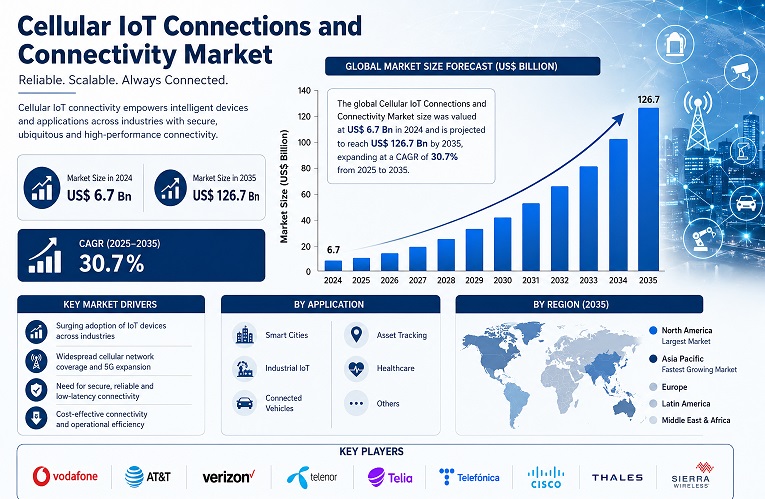
The global Cellular IoT Connections and Connectivity Market was valued at approximately USD 6.7 billion in 2024 and is projected to reach around USD 126.7 billion by 2035, expanding at a CAGR of 30.7% during the forecast period. The market growth is primarily driven by the rapid proliferation of connected devices, increasing adoption of smart city initiatives, rising deployment of industrial automation solutions, and the ongoing expansion of 5G networks.
Request the Sample Report: https://www.transparencymarketresearch.com/sample/sample.php?flag=S&rep_id=77351
Market Overview
Cellular IoT has become a critical component of digital transformation initiatives. Unlike traditional connectivity technologies, cellular IoT provides extensive geographic coverage, robust security, and the ability to support large numbers of devices simultaneously. The evolution of low-power wide-area network (LPWAN) technologies such as Narrowband IoT (NB-IoT) and LTE-M has further accelerated adoption by enabling cost-effective and energy-efficient connectivity for battery-powered devices.
As industries move toward automation and intelligent operations, cellular IoT solutions are being deployed in applications ranging from asset tracking and predictive maintenance to smart metering and connected healthcare systems. The ongoing rollout of 5G networks is expected to significantly enhance the capabilities of cellular IoT by delivering ultra-low latency, higher bandwidth, and massive machine-type communication.
Key Market Drivers
Rising Adoption of Smart Devices
The growing penetration of connected devices across industries is one of the primary drivers of the Cellular IoT Connections and Connectivity Market. Smart sensors, wearable devices, industrial equipment, and connected vehicles all require reliable communication networks to function effectively.
Expansion of Smart Cities
Governments and municipal authorities worldwide are investing heavily in smart city projects to improve urban infrastructure and public services. Cellular IoT technologies are widely used in intelligent traffic management systems, smart lighting, waste management, environmental monitoring, and public safety applications.
Increasing Industrial Automation
Industries are increasingly adopting Industry 4.0 technologies to improve productivity and operational efficiency. Cellular IoT enables real-time monitoring of equipment, predictive maintenance, and automated production processes, thereby reducing downtime and operational costs.
Growth of Connected Vehicles
The automotive industry is rapidly embracing connected vehicle technologies. Cellular connectivity enables vehicle telematics, remote diagnostics, fleet management, navigation systems, and vehicle-to-everything (V2X) communication, contributing significantly to market growth.
Emergence of 5G Networks
The deployment of 5G infrastructure is creating new opportunities for cellular IoT applications. 5G networks support higher device density, faster data transmission, and ultra-reliable low-latency communication, making them ideal for mission-critical applications.
Buy now for expert market outlook: https://www.transparencymarketresearch.com/checkout.php?rep_id=77351<ype=S
Market Segmentation
By Network
- 2G
- 3G
- 4G/LTE
- 5G
- Low Power Wide Area Network
- Narrowband IoT
- LTE for Machines
- Others
By Component
- Hardware
- Software & Services
By Service Providers
- Managed Service Providers (MSPs)
- Mobile Network Operators (MNOs)
- Connectivity Platform Providers
- IoT Solution Providers
- Others
By End-user
- Transportation & Logistics
- Retail
- Agriculture
- Automotive
- Consumer Electronics
- Manufacturing
- Healthcare
- Building Automation
- Energy & Utilities
- Others
Role of LPWAN Technologies
Low-Power Wide-Area Network technologies such as NB-IoT and LTE-M have transformed the cellular IoT ecosystem. These technologies are specifically designed to support devices that require low power consumption and infrequent data transmission.
NB-IoT is particularly suitable for applications such as smart meters and environmental monitoring sensors that need long battery life and deep indoor coverage. LTE-M, on the other hand, supports mobility and voice capabilities, making it ideal for asset tracking and wearable devices.
The growing adoption of LPWAN technologies is enabling enterprises to deploy large-scale IoT networks while maintaining cost efficiency and operational reliability.
Regional Analysis
North America
North America holds a substantial share of the Cellular IoT Connections and Connectivity Market due to early adoption of advanced communication technologies, widespread deployment of smart devices, and significant investments in 5G infrastructure. The presence of major technology providers and telecommunications companies further strengthens regional market growth.
Europe
Europe is witnessing steady growth driven by increasing smart city initiatives, industrial automation projects, and stringent regulations promoting energy efficiency and sustainability. Countries such as Germany, the United Kingdom, and France are actively deploying cellular IoT solutions across multiple sectors.
Asia-Pacific
The Asia-Pacific region is expected to experience the fastest growth during the forecast period. Rapid industrialization, expanding telecommunications infrastructure, and increasing adoption of connected technologies in countries such as China, India, Japan, and South Korea are driving market expansion.
Large-scale smart city projects, increasing penetration of connected vehicles, and supportive government initiatives are further accelerating cellular IoT adoption across the region.
Latin America and Middle East & Africa
These regions are gradually adopting cellular IoT technologies due to increasing digital transformation initiatives and growing investments in telecommunications infrastructure. Smart utility management, agriculture monitoring, and transportation applications are expected to create significant growth opportunities.
Emerging Trends
Integration of Artificial Intelligence
Artificial intelligence and machine learning technologies are increasingly being integrated with cellular IoT solutions to enable predictive analytics, automated decision-making, and intelligent process optimization.
Adoption of Edge Computing
Edge computing is becoming increasingly important in cellular IoT environments as it allows data processing closer to the source of data generation. This reduces latency and improves operational efficiency for real-time applications.
Growth of eSIM Technology
Embedded SIM technology simplifies device management and enables remote provisioning of connectivity services. The growing adoption of eSIM solutions is expected to facilitate large-scale deployment of IoT devices.
Enhanced Security Solutions
As the number of connected devices increases, cybersecurity has become a major priority. Companies are investing in advanced encryption technologies, identity management systems, and secure authentication mechanisms to protect cellular IoT networks.
Competitive Landscape
The Cellular IoT Connections and Connectivity Market is highly competitive and includes telecommunications providers, connectivity platform vendors, chipset manufacturers, and cloud service providers. Companies are focusing on expanding network coverage, developing advanced connectivity platforms, and establishing strategic partnerships to strengthen their market positions.
Market participants are also investing heavily in research and development activities to introduce innovative solutions capable of supporting emerging applications such as autonomous vehicles, smart factories, and remote healthcare services.
Future Outlook
The future of the Cellular IoT Connections and Connectivity Market appears highly promising as digital transformation initiatives continue to accelerate worldwide. The increasing deployment of 5G networks, rising adoption of smart devices, and growing demand for real-time connectivity solutions are expected to drive significant market expansion over the coming years.
Furthermore, advancements in LPWAN technologies, artificial intelligence, and edge computing will continue to enhance the capabilities of cellular IoT ecosystems. As organizations increasingly recognize the value of connected technologies in improving efficiency and enabling data-driven decision-making, the demand for cellular IoT connections and connectivity solutions is expected to witness sustained growth across various industries.
More Trending Reports by Transparency Market Research –
Flex Banner Market – https://www.transparencymarketresearch.com/flex-banner-market.html
Marker Pen Market – https://www.transparencymarketresearch.com/marker-pen-market.html
Media Contact:
Abhishek Budholiya
Transparency Market Research Inc.
State Tower, 90 State Street, Suite 700,
Albany NY – 12207, United States
Tel: +1-518-618-1030
USA – Canada Toll Free: 866-552-3453
Website: https://www.transparencymarketresearch.com
Sales Inquiries: sales@transparencymarketresearch.com
Media Inquiries: media@transparencymarketresearch.com