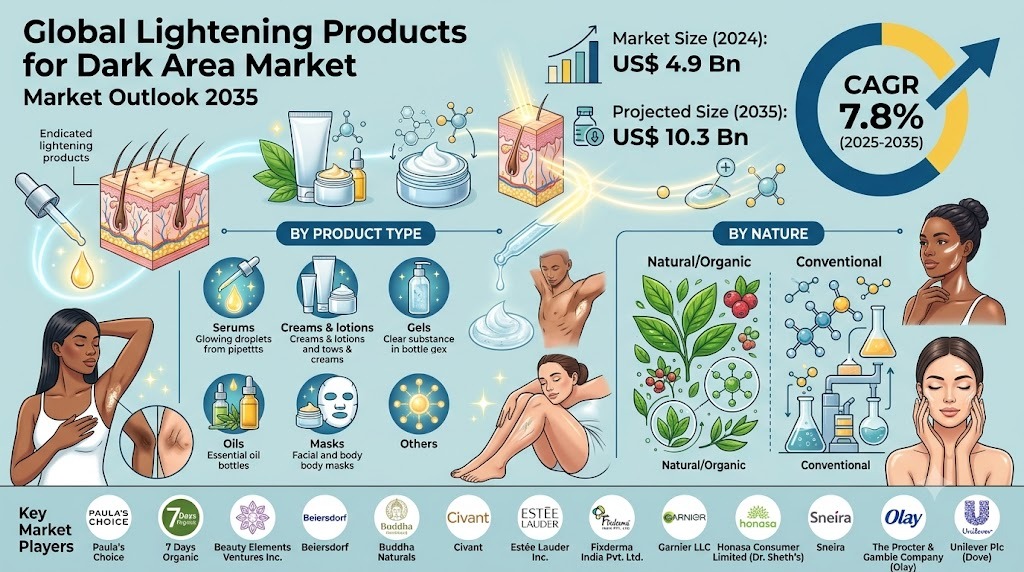
The global lightening products for dark area market is witnessing steady expansion as consumers increasingly seek specialized skincare products designed to address hyperpigmentation in sensitive body areas. According to recent market analysis, the industry was valued at US$4.9 billion in 2024 and is projected to reach US$10.3 billion by 2035, registering a compound annual growth rate (CAGR) of 7.8% during the forecast period from 2025 to 2035. The market’s sustained growth reflects the increasing adoption of targeted skincare solutions, rising consumer awareness regarding body pigmentation concerns, and continuous advancements in dermatologically tested formulations. As manufacturers introduce innovative products with safer ingredients and enhanced efficacy, the market is expected to maintain strong momentum throughout the forecast period.
Market Overview
The lightening products for dark area market has evolved significantly over the past decade, transforming from a niche cosmetic category into a mainstream segment of the global skincare industry. Products formulated for underarms, inner thighs, knees, elbows, neck, and intimate areas are gaining widespread acceptance among consumers seeking even skin tone and improved skin appearance. Unlike conventional skin-lightening products, modern formulations emphasize gradual tone correction, hydration, and skin barrier protection while minimizing irritation. The growing preference for ingredient transparency, dermatologist-approved formulations, and naturally derived active ingredients has further strengthened consumer confidence in this category. In addition, increased availability through online retail platforms, pharmacies, supermarkets, and specialty beauty stores has improved accessibility, enabling manufacturers to reach a broader consumer base across both developed and emerging economies.
Key Market Growth Drivers
The primary factors driving the growth of the global lightening products for dark area market include rising awareness of hyperpigmentation, changing personal care preferences, and increasing demand for specialized body skincare products. Consumers are becoming more informed about pigmentation caused by friction, hormonal fluctuations, aging, shaving, and post-inflammatory skin conditions, leading to greater adoption of targeted treatment products. Social media platforms, beauty influencers, and educational campaigns have also contributed to reducing stigma surrounding intimate skincare while encouraging informed purchasing decisions.
The growing popularity of professional skincare treatments offered by spas, salons, dermatology clinics, and aesthetic centers has further accelerated market demand. Many clinics now recommend post-treatment skincare products to maintain clinical results, encouraging long-term product usage among consumers. Product innovation also continues to play a vital role, with manufacturers introducing formulations containing niacinamide, kojic acid, alpha arbutin, vitamin C derivatives, lactic acid, licorice extract, and botanical oils that provide effective pigmentation correction while remaining gentle on sensitive skin. Increasing regulatory emphasis on product safety, ingredient disclosure, and scientifically validated claims has also enhanced consumer trust and strengthened market growth.
Analysis of Key Players – Key Player Strategies
The competitive landscape remains highly dynamic, with leading companies focusing on innovation, clinical validation, product diversification, and global expansion to strengthen their market positions. Major manufacturers operating in the market include Estée Lauder Inc., Unilever Plc (Dove), The Procter & Gamble Company (Olay), Beiersdorf, Garnier LLC, Paula’s Choice, Civant, Fixderma India Pvt. Ltd., Honasa Consumer Limited (Dr. Sheth’s), Buddha Naturals, Beauty Elements Ventures Inc., Sneira, and 7 Days Organic.
These companies are investing heavily in research and development to formulate safer products that address pigmentation concerns while supporting skin barrier health. Dermatologist-tested formulations, fragrance-free products, plant-based active ingredients, and clinically supported efficacy have become central to product development strategies. Several leading brands are expanding their portfolios to include dedicated intimate care and body tone-evening solutions while strengthening collaborations with dermatologists, aesthetic clinics, pharmacies, and beauty retailers. Digital marketing, educational campaigns, influencer partnerships, and e-commerce expansion continue to enhance consumer engagement and improve brand visibility across global markets.
Market Challenges & Opportunities
Despite its promising outlook, the global lightening products for dark area market faces several challenges. Regulatory scrutiny surrounding skin-lightening claims continues to intensify across various countries, requiring manufacturers to ensure compliance with evolving cosmetic safety regulations and ingredient standards. Consumer concerns regarding product safety, unrealistic marketing claims, and potential skin irritation remain important considerations that companies must address through transparent labeling and clinical validation. Additionally, increasing competition among established multinational brands and emerging regional manufacturers creates pricing pressure and necessitates continuous product innovation.
At the same time, the market presents substantial growth opportunities. Rising demand for clean beauty products, natural formulations, and dermatologist-recommended skincare solutions creates favorable conditions for product innovation. Expanding male grooming trends, increasing urbanization, higher disposable incomes, and growing skincare awareness across developing economies are expected to generate new revenue streams. The continued expansion of e-commerce platforms and direct-to-consumer business models also enables manufacturers to reach underserved markets while providing personalized skincare recommendations and educational content that supports responsible product usage.
Key Player Strategies
Leading market participants are increasingly adopting multi-dimensional growth strategies to strengthen their competitive positions. Companies are emphasizing research-driven innovation by incorporating scientifically validated active ingredients into formulations specifically designed for sensitive body areas. Investment in dermatological testing, ingredient transparency, and safety certifications has become essential for building long-term consumer trust.
Manufacturers are also expanding their global distribution networks through partnerships with pharmacies, supermarkets, specialty retailers, and online marketplaces. Strategic acquisitions and collaborations remain important growth initiatives, enabling companies to strengthen their product portfolios and enter emerging markets more efficiently. Marketing strategies have shifted toward consumer education rather than promotional messaging alone, with brands providing detailed guidance on product usage, expected outcomes, and skin safety. These initiatives not only improve customer satisfaction but also reinforce brand credibility in an increasingly regulated market environment.
Investment Landscape and ROI Outlook
The global lightening products for dark area market presents attractive investment opportunities driven by sustained consumer demand, product innovation, and expanding distribution channels. Investors continue to view the market favorably due to its consistent growth trajectory, increasing penetration across emerging economies, and strong demand for premium skincare solutions. The shift toward clinically validated formulations and natural ingredient-based products has created opportunities for companies specializing in research, ingredient manufacturing, and dermatological skincare.
Asia Pacific remains the most attractive investment destination owing to its large consumer base, established manufacturing capabilities, growing middle-class population, and increasing skincare awareness. Countries such as India, China, Japan, South Korea, and Thailand continue to attract investments in production facilities, research and development centers, and product innovation initiatives. As consumer spending on personal care products continues to rise globally, companies investing in product differentiation, regulatory compliance, and digital commerce are expected to achieve favorable long-term returns on investment.
Market Segmentations
The global lightening products for dark area market is segmented across multiple categories to address diverse consumer preferences and purchasing behaviors. Based on product type, the market includes serums, creams and lotions, gels, oils, masks, and other products such as soaps, with creams and lotions accounting for the largest market share due to their ease of application and suitability for daily use. By nature, the market is categorized into natural or organic products and conventional formulations. Based on target body area, products are developed for underarms, inner thighs, intimate areas and buttocks, knees and elbows, and the neck. Gender-wise, the market serves both women and men, reflecting the expanding consumer base for specialized body skincare. Packaging formats include tubes, bottles, droppers, roll-ons, jars, and sachets, while distribution channels comprise company-owned websites, e-commerce platforms, supermarkets, hypermarkets, specialty stores, department stores, pharmacies, drugstores, convenience stores, and independent retailers.
From a regional perspective, Asia Pacific dominated the global market in 2024 by accounting for 47.3% of total revenue, supported by strong skincare culture, large population, advanced manufacturing capabilities, and continuous product innovation. North America and Europe continue to represent mature markets characterized by high consumer awareness, stringent regulatory standards, and premium product demand. Latin America and the Middle East & Africa are also expected to experience steady growth as skincare awareness, retail accessibility, and disposable incomes continue to improve.
Why Buy This Report?
This comprehensive market report provides an in-depth assessment of the global lightening products for dark area industry by delivering detailed market size estimates, growth forecasts, competitive analysis, emerging trends, and regional insights. It evaluates key market drivers, challenges, opportunities, investment prospects, and strategic developments influencing industry growth through 2035. The report also offers extensive segmentation analysis across product types, target body areas, distribution channels, packaging formats, gender, and regions, enabling businesses to identify high-growth opportunities. In addition, company profiling, competitive benchmarking, and analysis of recent industry developments help manufacturers, investors, distributors, and stakeholders make informed strategic decisions in an evolving global marketplace.
FAQs
What is the projected value of the global lightening products for dark area market by 2035?
The market is projected to reach US$10.3 billion by 2035, growing at a CAGR of 7.8% during the forecast period.
Which region dominates the global market?
Asia Pacific leads the global market, accounting for 47.3% of total revenue in 2024, driven by high consumer demand, strong manufacturing capabilities, and continuous product innovation.
Which product segment holds the largest market share?
Creams and lotions represent the largest product segment, capturing 38.5% of the global market in 2024 due to their convenience, effectiveness, and suitability for regular use.
Who are the major companies operating in the market?
Leading participants include Estée Lauder Inc., Unilever Plc (Dove), The Procter & Gamble Company (Olay), Beiersdorf, Garnier LLC, Paula’s Choice, Civant, Fixderma India Pvt. Ltd., Honasa Consumer Limited (Dr. Sheth’s), Buddha Naturals, Beauty Elements Ventures Inc., Sneira, and 7 Days Organic.
What are the major factors driving market growth?
The market is primarily driven by rising awareness of hyperpigmentation, growing demand for specialized body skincare products, increasing popularity of professional aesthetic treatments, continuous product innovation, expanding e-commerce channels, and stronger emphasis on ingredient safety, dermatologist-tested formulations, and regulatory compliance.