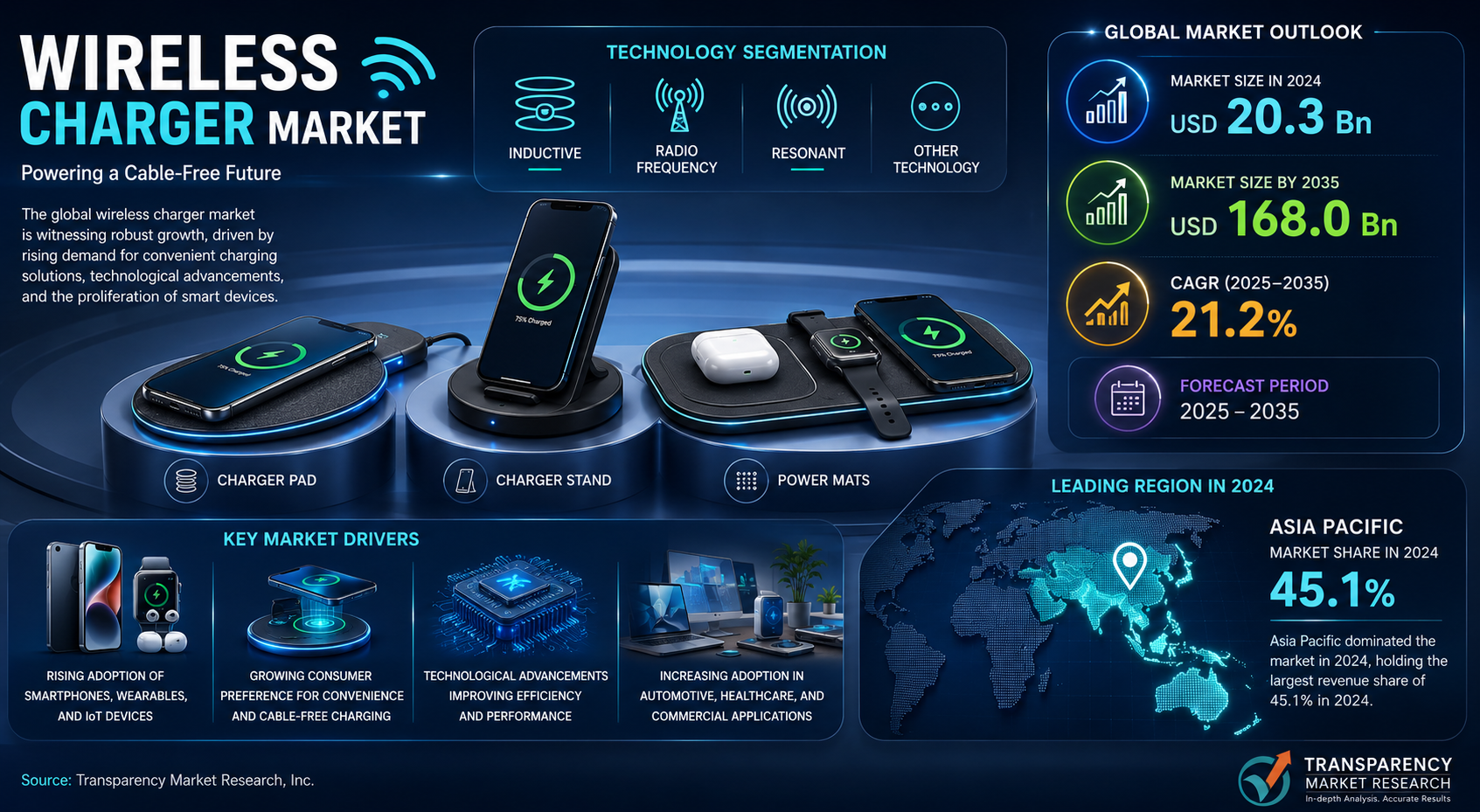
The wireless charger market was valued at USD 20.3 billion in 2024 and is projected to reach USD 168.0 billion by 2035. The industry is expected to witness strong growth at a CAGR of 21.2% from 2025 to 2035, driven by increasing adoption of wireless charging technologies across smartphones, consumer electronics, electric vehicles, and smart devices.
👉 Get sample market research report copy today@ https://www.transparencymarketresearch.com/sample/sample.php?flag=S&rep_id=18947
Market Overview
The wireless charger market involves the worldwide industry that facilitates the design, production, and distribution of units that allow the transfer of electric power to electronic devices without the need for any wires or connectors. The main technology used by the wireless chargers is electromagnetic induction, magnetic resonance, or RF, which enables the charging of compatible devices just by putting them on a charging spot or near a charging spot.
The market comprises a wide variety of products, including charging pads, stands, mounts, multi-device charging stations, and embedded wireless charging modules, and also includes transmitters, receivers, and power management systems as supporting components. Wireless chargers are regarded as their main advantages, namely convenience, no cable wear, higher safety, and better user experience, particularly in places where frequent plugging and unplugging of devices is not practical.
The wireless charger market is mainly influenced by the continuous improvements in fast-charging capacities, energy consumption, heat management, and freedom of space. As well as the increasing use of smart devices and the growing focus on the use of cables that are not visible and technology that is minimalistic in all three areas, namely residential, commercial, and mobility.
Analysts’ Viewpoint
The wireless charger market is becoming a major part of the entire consumer electronics and power solutions fields. Wireless charging has transitioned from being a convenience feature to an essential expectation due to improvements in charging speed, interoperability standards, and compactness.
Charger pads, among the different product types, dominate the market, as they are easy to use, cost-effective, and appropriate for large-scale deployment in residential, commercial, and public areas. Their flat structure and easy integration into the furniture and infrastructure allow them to be scaled commercially.
Asia-Pacific is the biggest market for wireless chargers globally, backed by the fact that it has a strong electronics manufacturing ecosystem, high consumer device penetration, and short distances between component suppliers and OEMs. The region’s market leadership indicates that it is both – a production hotspot and a major user of wireless-charging-compatible devices. In general, the market is marked by continuous acceptance, standardization, and growing consumer and industrial applications’ usage.
Analysis of Key Players
The competitive landscape is seeing massive capital deployment toward high-frequency Gallium Nitride (GaN) circuit architectures, specialized magnetic resonance engineering, and cross-industry standard alignment.
Leading companies operating in the global wireless charger market include:
- Anker Innovations Co., Ltd.
- Apple Inc.
- Belkin International, Inc.
- ConvenientPower NZ
- Energizer Holdings, Inc.
- Energous Corporation
- Huawei Technologies Co., Ltd.
- Legrand SA
- Murata Manufacturing Co., Ltd.
- NXP Semiconductors N.V.
- Powermat Technologies Ltd.
- Qualcomm Incorporated
- Renesas Electronics Corporation
- Samsung Electronics Co., Ltd.
- Sony Group Corporation
- STMicroelectronics N.V.
- Texas Instruments Incorporated
- WiTricity Corporation
- Xiaomi Corporation
- Zens B.V.
- Other Prominent Players
Strategic technology licensing and hardware partnerships are highly prevalent. Market leaders focus heavily on partnering with global automotive manufacturers and public furniture providers to embed invisible, multi-device wireless transmitters directly into vehicle cockpits and urban infrastructure points.
Recent Developments (2025-2026)
- In September 2025, Apple announced the iPhone 17 lineup along with a new Qi2 25W-certified MagSafe Charger, strengthening its wireless charging ecosystem. The company highlighted faster, more efficient charging and improved magnetic alignment, positioning the accessory as a key companion for next-generation iPhones and compatible Qi2 devices.
- In April 2025, Powermat Technologies signed a patent license agreement with Panasonic Automotive Systems Co., Ltd, thereby granting them access to Powermat’s extensive patent portfolio. The agreement aims to enable a 100% wireless future, ensuring seamless power access without wires and addressing OEM business challenges.
- In January 2025, InductEV partnered with International Transportation Service (ITS) to deploy high-power wireless inductive chargers at the Port of Long Beach supported by a California Energy Commission grant, enabling hands-free charging of battery-electric cargo handling equipment for medium- and heavy-duty electric vehicle operations.
👉 Discuss Implications for Your Industry Request Sample Research Report PDF@ https://www.transparencymarketresearch.com/sample/sample.php?flag=B&rep_id=18947
Key Developments & Trends
- Magnetic Qi2 Standardization: Rapid deployment of magnetic alignment rings within charging transmitters to lock receivers into the optimal position for minimal energy transfer loss.
- GaN-Powered Circuitry: Integration of Gallium Nitride semiconductors into wireless charging hubs, allowing smaller, cooler, and significantly higher wattage power footprints.
- Kilowatt-Scale Resonant Systems: Breakthrough deployments of ultra-high-output wireless chargers built specifically for automated warehouse robotics and passenger electric vehicles.
- Multi-Device Spatial Charging: Evolution of multi-coil mats that allow consumers to drop smartphones, smartwatches, and wireless earbuds anywhere on the surface without precise placement rules.
- Infrastructure Integration: Embedding wireless transmitter nodes directly into architectural materials, such as corporate desks, airport terminal seating, and restaurant countertops.
Challenges
- Thermal Management Gaps: Extended high-power wireless transmission creates localized heat generation, requiring complex cooling measures to protect device battery lifespans.
- Lower Energy Efficiency: Wireless charging systems naturally lose more energy as heat compared to direct copper-to-copper wired connections, raising overall power consumption.
- High Infrastructure Installation Costs: Deploying heavy-duty wireless charging pads beneath municipal roads or parking lots requires intensive capital outlay and structural retrofitting.
- Foreign Object Risks: Metallic items (like coins or keys) dropped onto active transmitter surfaces can trigger rapid inductive heating, requiring advanced safety sensors to prevent safety hazards.
Opportunities
- Automotive Cockpit Standardization: Equipping new commercial and passenger vehicles with integrated, high-wattage smart wireless charging trays as part of baseline infotainment specifications.
- Sealed Healthcare Equipment: Utilizing completely enclosed wireless charging structures for medical tablets and diagnostic equipment to facilitate full chemical sterilization in sterile hospital wards.
- Industrial AGV Automation: Installing automated resonant charging plates on warehouse floors, enabling logistical robots to top-off their power banks autonomously during short operational pauses.
- Premium Smart Furniture: Partnering with commercial office and hotel developers to supply office desks and bedside tables featuring built-in, invisible charging spots.
Market Segmentation
➤ By Technology
- Inductive Charging (Leading Segment – Capturing over ~65% share due to its established reliability and mass adoption in smartphone ecosystems)
- Magnetic Resonance (Fastest Growing Segment – Surging due to its high tolerance for distance and spatial misalignment, ideal for EVs and industrial use)
- Radio Frequency (RF) & Others (Emerging Segment – Expanding for low-power IoT sensors and specialized micro-medical implants)
➤ By Component
- Transmitters (Charging Pads/Stations) (Leading Segment – Accounts for over ~66% of revenue driven by infrastructure installation and consumer accessory purchases)
- Receivers (Internal Chips/Coils) (High Growth Segment – Supported by the mandatory integration of wireless coils into modern electronic devices)
➤ By Application
- Consumer Electronics (Leading Segment – Continues to command the highest total volume due to the global ubiquity of smartphones and wearables)
- Automotive (Fastest Growing Segment – Expanding rapidly via cabin console integration and public wireless EV charging developments)
- Industrial, Healthcare, & Defense (High Value Segment – Growing due to the deployment of autonomous factory robotics and sealed clinical equipment)
Conclusion
The wireless charger industry is the central facilitator of the port-free, automated digital future. Through 2036, long-term success will be defined by power density and smart material integration. As industrial and consumer sectors phase out vulnerable mechanical connectors in favor of resilient, sealed device enclosures, the component manufacturers and accessory brands that master high-efficiency GaN power stages, precise thermal management, and reliable high-wattage resonance will control the next decade of the electronic supply chain.
👉 To buy this comprehensive market research report, click here to inquire@ https://www.transparencymarketresearch.com/checkout.php?rep_id=18947<ype=S
About Transparency Market Research
Transparency Market Research, a global market research company registered at Wilmington, Delaware, United States, provides custom research and consulting services. Our exclusive blend of quantitative forecasting and trends analysis provides forward-looking insights for thousands of decision makers. Our experienced team of Analysts, Researchers, and Consultants use proprietary data sources and various tools & techniques to gather and analyses information.
Our data repository is continuously updated and revised by a team of research experts, so that it always reflects the latest trends and information. With a broad research and analysis capability, Transparency Market Research employs rigorous primary and secondary research techniques in developing distinctive data sets and research material for business reports.
Contact:
Abhishek Budholiya
Transparency Market Research Inc.
State Tower, 90 State Street, Suite 700,
Albany NY – 12207, United States
Tel: +1-518-618-1030
USA – Canada Toll Free: 866-552-3453
Website: https://www.transparencymarketresearch.com
Sales Inquiries: sales@transparencymarketresearch.com
Media Inquiries: media@transparencymarketresearch.com