The global spa equipment market size was valued at US$ 34.0 Bn in 2024 and is projected to reach US$ 67.9 Bn by 2035, expanding at a CAGR of 6.5% from 2025 to 2035. The market is witnessing robust growth owing to increasing consumer awareness regarding wellness, relaxation, preventive healthcare, and beauty treatments. Growing investments in hospitality spas, medical spas, wellness centers, and home-based spa solutions are further supporting market expansion.
→Discover Market Opportunities – Request Your Sample Copy Now: https://www.transparencymarketresearch.com/sample/sample.php?flag=S&rep_id=86903
Spa Equipment Market Size & Highlights
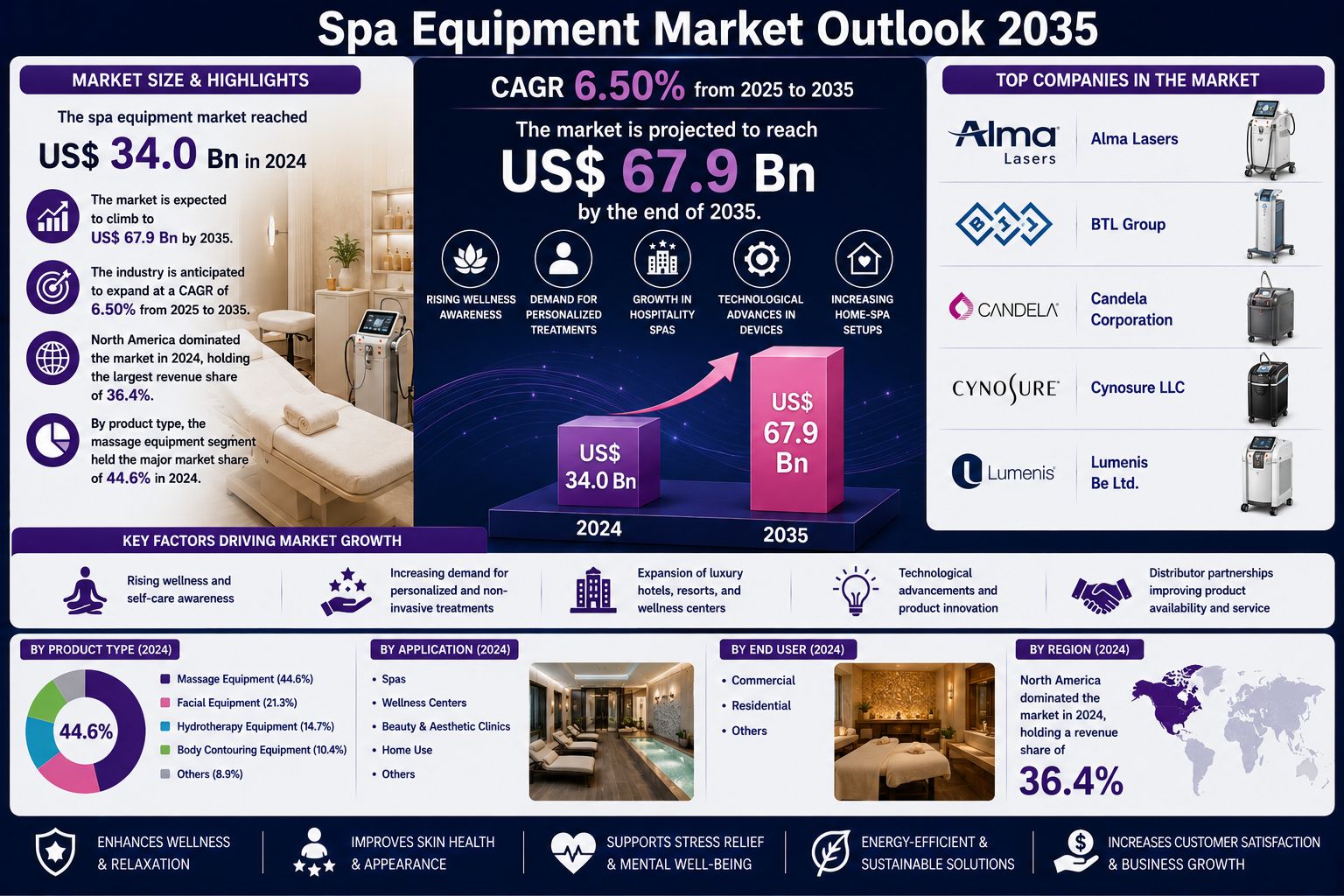
The global spa equipment market reached US$ 34.0 Bn in 2024 and is anticipated to attain US$ 67.9 Bn by the end of 2035. The industry is expected to expand at a CAGR of 6.5% during the forecast period.
North America emerged as the leading regional market in 2024, accounting for 36.4% of the global revenue share. By product type, massage equipment dominated the market with a share of 44.6% owing to its widespread adoption across commercial spas, wellness centers, hotels, resorts, and residential applications.
Major companies operating in the market include Alma Lasers, BTL Group, Candela Corporation, Cynosure LLC, Lumenis Be Ltd., Cutera, Inc., EarthLite LLC, Gharieni Group, Hydrafacial LLC, Lemi Group srl, Oakworks, Inc., Pibbs Industries, Takara Belmont, Collins, and Deka Medical Aesthetic.
Analysts’ Viewpoint on the Global Spa Equipment Market
The global spa equipment market is evolving rapidly as wellness transitions from a luxury lifestyle choice to an integral component of preventive healthcare and personal well-being. Consumers are increasingly seeking professional treatments that enhance physical relaxation, mental wellness, skin health, and aesthetic appearance.
Growing awareness regarding stress management, holistic therapies, anti-aging treatments, and skincare solutions has significantly increased demand for advanced spa equipment. Technologies such as hydrotherapy systems, infrared saunas, intelligent massage chairs, facial rejuvenation platforms, and body contouring devices are becoming essential components of modern spa facilities.
Technological advancements continue to reshape the market through the introduction of smart, connected, and customizable equipment. Integrated digital controls, AI-powered treatment customization, sensor-based operation, and remote monitoring capabilities are enhancing both customer experience and operational efficiency.
Sustainability has also emerged as a key focus area. Manufacturers are increasingly investing in energy-efficient systems, eco-friendly materials, water-saving technologies, and natural treatment solutions that align with growing environmental awareness among consumers and businesses.
The expansion of medical spas and aesthetic clinics has further accelerated demand for specialized devices used in dermatological treatments, skin rejuvenation, body sculpting, hair removal, and anti-aging procedures. As wellness, aesthetics, and healthcare continue to converge, the spa equipment market is expected to experience sustained growth throughout the forecast period.
Spa Equipment Market Introduction
The spa equipment market encompasses a broad range of products and technologies used to deliver wellness, beauty, relaxation, therapeutic, and aesthetic treatments across commercial and residential settings.
These products include massage chairs, massage tables, hydrotherapy tubs, facial steamers, microdermabrasion machines, sauna systems, steam cabins, body contouring devices, laser-based aesthetic equipment, radiofrequency systems, manicure and pedicure units, sterilization equipment, and water purification systems.
Spa equipment is utilized in day spas, destination spas, hotel and resort spas, medical spas, dermatology clinics, plastic surgery centers, wellness facilities, fitness centers, and increasingly within residential wellness spaces.
Modern spa equipment supports a diverse range of services, including relaxation therapy, skin rejuvenation, hydrotherapy, body contouring, anti-aging treatments, hair removal, thermal therapy, and corrective dermatological procedures. Manufacturers increasingly provide integrated solutions that combine equipment, software, consumables, training, maintenance services, and digital management tools to improve operational efficiency and customer satisfaction.
Rising Focus on Health and Relaxation Driving Market Growth
The increasing emphasis on wellness and stress management has become one of the most significant growth drivers for the spa equipment market. Consumers are actively investing in products and services that support mental well-being, physical recovery, relaxation, and preventive healthcare.
The global wellness economy has experienced substantial expansion over the past decade. The growing number of wellness facilities worldwide has created strong demand for advanced spa infrastructure and treatment equipment. As spa operators seek to enhance customer experiences, investments in premium massage systems, hydrotherapy equipment, sensory treatment rooms, and wellness technologies continue to increase.
The hospitality industry has emerged as a major contributor to this growth. Hotels, resorts, cruise operators, and destination wellness centers increasingly view spa facilities as critical differentiators capable of attracting high-value customers. Consequently, investments in advanced spa equipment have become a strategic priority for hospitality operators.
Corporate wellness initiatives are also contributing to market expansion. Organizations increasingly recognize the benefits of wellness programs in improving employee productivity, reducing stress, and enhancing workplace satisfaction. This trend is creating opportunities for wellness centers and spa facilities to expand their service offerings.
The growing consumer preference for holistic health solutions is expected to sustain demand for spa equipment across both commercial and residential segments.
Increasing Demand for Anti-Aging and Skin Treatments Accelerating Market Expansion
The rising global demand for anti-aging solutions and aesthetic treatments represents another major growth catalyst for the spa equipment market.
Consumers are becoming increasingly proactive about maintaining youthful appearances, improving skin health, and addressing cosmetic concerns through non-invasive procedures. This trend has fueled demand for advanced spa technologies designed to support skin rejuvenation, wrinkle reduction, pigmentation correction, and body contouring.
Equipment such as radiofrequency systems, laser platforms, intense pulsed light (IPL) devices, microdermabrasion machines, and multifunction facial treatment systems are gaining widespread adoption among spas and aesthetic clinics. These technologies offer effective solutions while minimizing recovery time and procedural risks compared to invasive surgical alternatives.
The growing popularity of medical spas has further strengthened market demand. Medical spas combine traditional wellness services with physician-supervised aesthetic treatments, creating a unique environment that requires sophisticated and clinically advanced equipment.
Manufacturers such as Cynosure, Candela, Alma Lasers, and Lumenis continue to introduce innovative platforms that address multiple skin and body concerns through customizable treatment protocols. As aging populations continue to expand globally and consumer spending on personal appearance increases, demand for anti-aging spa equipment is expected to remain strong.
Massage Equipment Segment Leads the Market
Massage equipment emerged as the largest product segment in 2024, accounting for 44.6% of the global market share.
The segment’s dominance is primarily attributed to the widespread popularity of massage therapies for stress reduction, muscle recovery, pain relief, and overall wellness enhancement. Massage equipment includes massage chairs, massage tables, therapy beds, handheld devices, and portable massage systems.
Consumers increasingly recognize the physical and mental health benefits associated with regular massage treatments. This awareness has driven demand across commercial establishments as well as residential environments.
Modern massage chairs have evolved significantly, incorporating features such as zero-gravity positioning, air compression systems, heat therapy, body scanning technology, customizable treatment programs, and integrated entertainment systems. These innovations have expanded the appeal of massage equipment among consumers seeking convenient home-based wellness solutions.
Commercial spa operators continue to invest in premium massage systems to improve service quality, enhance customer satisfaction, and differentiate their offerings in increasingly competitive markets. The segment is expected to maintain its leadership position throughout the forecast period.
→Explore Strategies & Trends – Request Full Report Access – https://www.transparencymarketresearch.com/sample/sample.php?flag=S&rep_id=86903
Regional Outlook of Spa Equipment Market
North America accounted for the largest share of the global spa equipment market in 2024, representing 36.4% of total revenue.
The region benefits from a well-established wellness culture, high disposable incomes, advanced healthcare infrastructure, and strong consumer spending on personal care and aesthetic services. The United States remains the primary contributor to regional growth due to its extensive network of spas, wellness centers, dermatology clinics, and medical aesthetic facilities.
Consumers across North America demonstrate a strong preference for premium wellness experiences, driving demand for advanced spa technologies and luxury treatment equipment. The region also hosts several leading spa equipment manufacturers and technology innovators, strengthening its position within the global market.
Medical spa services have gained significant popularity throughout North America as consumers increasingly seek non-invasive aesthetic procedures. This trend continues to support investments in advanced aesthetic equipment, laser systems, body contouring technologies, and skin rejuvenation platforms.
Europe represents another important regional market, supported by strong wellness tourism, established spa traditions, and increasing demand for sustainable wellness solutions. Asia Pacific is expected to witness the fastest growth during the forecast period due to rising disposable incomes, expanding middle-class populations, increasing urbanization, and growing awareness of personal wellness and beauty treatments.
Analysis of Key Players in the Spa Equipment Market
The global spa equipment market is highly competitive, with leading manufacturers focusing on product innovation, technological advancements, strategic partnerships, acquisitions, and geographic expansion.
Companies are investing heavily in smart technologies, digital integration, ergonomic design improvements, and sustainable manufacturing practices. The increasing demand for multifunctional systems capable of delivering personalized treatment experiences continues to drive product development activities.
Key market participants include Alma Lasers, BTL Group, Candela Corporation, Collins, Cutera, Inc., Cynosure LLC, Deka Medical Aesthetic, EarthLite LLC, Gharieni Group, Hydrafacial LLC, Lemi Group srl, Lumenis Be Ltd., Oakworks, Inc., Pibbs Industries, and Takara Belmont.
These companies continue to strengthen their market presence through expanded product portfolios, strategic collaborations, distribution partnerships, and investments in research and development.
Market Segmentation
The spa equipment market is segmented by product type into massage equipment, facial and skincare equipment, body treatment equipment, hair and nail care equipment, heat therapy equipment, and other specialized equipment.
Massage equipment includes massage tables, massage beds, massage chairs, and massage devices. Facial and skincare equipment encompasses facial steamers, microdermabrasion machines, hot towel cabinets, and magnifying lamps. Body treatment equipment includes hydrotherapy tubs, wax warmers, body contouring devices, and Vichy showers.
Heat therapy equipment consists of traditional saunas, infrared saunas, thermal loungers, and heated benches. Additional specialized equipment includes sterilizers, dehumidifiers, water purification systems, and laundry equipment.
Based on application, the market is segmented into face, body, hair, and other applications. By end-use, the market comprises individual users, day spas, hotel and resort spas, medical spas, aesthetic clinics, gyms, and wellness centers.
Distribution channels include business-to-business and business-to-consumer sales through online retailers, specialty stores, brand-owned outlets, supermarkets, and other retail formats.
Future Outlook
The future of the spa equipment market appears highly promising as wellness continues to become an essential component of modern lifestyles. The convergence of beauty, healthcare, relaxation, and technology is expected to create significant opportunities for manufacturers and service providers.
Growing consumer demand for personalized wellness experiences, increasing adoption of smart technologies, rising interest in non-invasive aesthetic procedures, and expanding wellness tourism will continue to support market growth. Sustainability initiatives and energy-efficient product development are also expected to play increasingly important roles in purchasing decisions.
As consumers place greater emphasis on preventive healthcare, stress management, and aesthetic enhancement, investments in advanced spa equipment are likely to increase across commercial and residential applications. With ongoing innovation and expanding global wellness infrastructure, the spa equipment market is well-positioned for sustained growth through 2035.
Buy Full Report Now: https://www.transparencymarketresearch.com/checkout.php?rep_id=86903<ype=S
→Explore Latest Research Reports by Transparency Market Research:
About Transparency Market Research
Transparency Market Research, a global market research company registered at Wilmington, Delaware, United States, provides custom research and consulting services. Our exclusive blend of quantitative forecasting and trends analysis provides forward-looking insights for thousands of decision makers. Our experienced team of Analysts, Researchers, and Consultants use proprietary data sources and various tools & techniques to gather and analyses information.
Our data repository is continuously updated and revised by a team of research experts, so that it always reflects the latest trends and information. With a broad research and analysis capability, Transparency Market Research employs rigorous primary and secondary research techniques in developing distinctive data sets and research material for business reports.
Media Contact:
Abhishek Budholiya
Transparency Market Research Inc.
State Tower, 90 State Street, Suite 700,
Albany NY – 12207, United States
Tel: +1-518-618-1030
USA – Canada Toll Free: 866-552-3453
Website: https://www.transparencymarketresearch.com
Sales Inquiries: sales@transparencymarketresearch.com
Media Inquiries: media@transparencymarketresearch.com