The global Regenerative Braking System (RBS) Market is witnessing robust growth as the automotive industry rapidly transitions toward electrification and energy-efficient mobility solutions. Increasing production of battery electric vehicles (BEVs), hybrid electric vehicles (HEVs), and plug-in hybrid electric vehicles (PHEVs), coupled with stringent emission regulations worldwide, is significantly boosting demand for regenerative braking technologies.
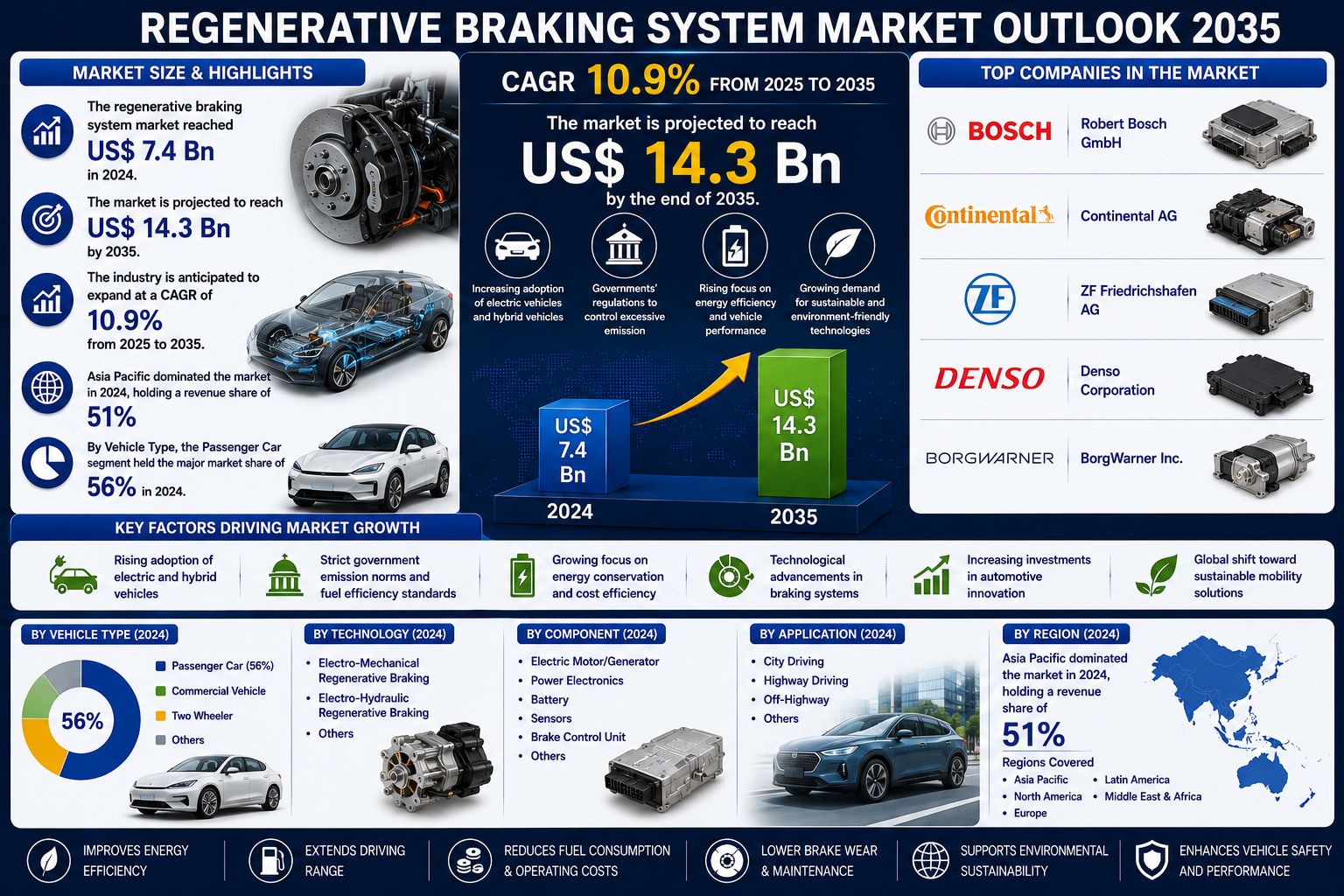
According to the latest market analysis, the global Regenerative Braking System Market was valued at US$ 7.4 Billion in 2024 and is projected to reach US$ 14.3 Billion by 2035, expanding at a CAGR of 10.9% from 2025 to 2035.
The technology enables vehicles to recover kinetic energy generated during braking and convert it into electrical energy stored in the battery, improving driving range, reducing energy consumption, and minimizing brake wear. As governments continue promoting clean transportation and automotive manufacturers invest heavily in next-generation electric mobility, regenerative braking systems are becoming an indispensable component of modern vehicle architectures.
→Discover Market Opportunities – Request Your Sample Copy Now: https://www.transparencymarketresearch.com/sample/sample.php?flag=S&rep_id=62694
Growing Adoption of Electric and Hybrid Vehicles Drives Market Expansion
The rapid global adoption of electric and hybrid vehicles remains the most significant factor fueling the growth of the Regenerative Braking System Market.
Unlike conventional vehicles that dissipate braking energy as heat, electric vehicles utilize regenerative braking to capture and reuse energy, significantly enhancing overall vehicle efficiency.
As consumers increasingly shift toward sustainable transportation, manufacturers are introducing broader portfolios of electric vehicles equipped with advanced regenerative braking systems.
Battery electric vehicles, plug-in hybrid electric vehicles, mild hybrid vehicles, and full hybrid vehicles all rely on regenerative braking technology to maximize energy recovery and extend battery performance.
With global electric vehicle sales reaching record levels annually, demand for efficient regenerative braking solutions continues to rise across passenger cars, commercial vehicles, and electric two-wheelers.
Automotive manufacturers are also optimizing regenerative braking algorithms to provide smoother braking performance, enhanced driving comfort, and improved vehicle safety while maximizing energy recuperation under varying driving conditions.
Stringent Emission Regulations Accelerate Technology Adoption
Governments worldwide are implementing increasingly stringent environmental regulations to reduce carbon emissions, improve energy efficiency, and accelerate vehicle electrification.
These regulatory initiatives have become a major catalyst for regenerative braking system adoption.
Emission standards such as Euro 7, Corporate Average Fuel Economy (CAFE) regulations, and similar fuel-efficiency mandates across Asia-Pacific and North America encourage manufacturers to integrate advanced energy recovery technologies into vehicle platforms.
Regenerative braking contributes significantly toward improving vehicle energy efficiency while reducing dependence on conventional friction braking systems.
Reduced usage of mechanical brakes also minimizes brake dust emissions, an emerging environmental concern addressed by newer emission regulations.
Government incentives promoting electric vehicles, zero-emission transportation, and sustainable mobility continue encouraging automotive manufacturers to expand regenerative braking technology across multiple vehicle categories.
These regulatory developments are expected to remain key long-term drivers supporting market expansion throughout the forecast period.
Advancements in Battery and Power Electronics Enhance Market Potential
Continuous technological innovation across electric drivetrains, battery systems, and power electronics is significantly improving regenerative braking system performance.
Modern electric vehicles now utilize highly efficient motor-generator units capable of recovering larger amounts of braking energy compared to earlier generations.
Advancements in lithium-ion battery technology enable faster energy acceptance during braking events while improving battery durability and charging efficiency.
Power electronics innovations further optimize energy conversion between electric motors and battery systems, maximizing regenerative braking effectiveness under various driving conditions.
Sophisticated vehicle control software now intelligently balances regenerative and friction braking to deliver smoother braking feel, enhanced vehicle stability, and optimized energy recovery.
These technological improvements continue increasing the attractiveness of regenerative braking systems among both automakers and consumers.
Economic Benefits Encourage Wider Adoption
Beyond environmental advantages, regenerative braking systems offer substantial economic benefits throughout a vehicle’s operating life.
By recovering energy that would otherwise be wasted during braking, regenerative systems improve vehicle efficiency and extend driving range, reducing electricity or fuel consumption.
Reduced reliance on conventional braking components significantly decreases brake pad and rotor wear, lowering maintenance costs over the lifetime of the vehicle.
Fleet operators particularly benefit from these operational savings, making regenerative braking increasingly attractive for commercial vehicles, public transportation systems, logistics fleets, and ride-sharing operators.
Improved battery utilization and enhanced drivetrain efficiency further contribute to lower total cost of ownership for electric and hybrid vehicles.
As businesses increasingly prioritize operational efficiency alongside sustainability goals, regenerative braking technology continues gaining widespread acceptance across commercial transportation applications.
→Explore Strategies & Trends – Request Full Report Access – https://www.transparencymarketresearch.com/sample/sample.php?flag=S&rep_id=62694
Passenger Cars Dominate the Regenerative Braking System Market
Among vehicle categories, Passenger Cars accounted for approximately 56% of global market revenue in 2024, making them the largest application segment.
The dominance of passenger vehicles is primarily attributed to the rapid increase in global production of electric and hybrid passenger cars.
Urban driving environments characterized by frequent stop-and-go traffic provide ideal operating conditions for regenerative braking systems, maximizing opportunities for energy recovery.
Automakers increasingly integrate regenerative braking as a standard feature across both premium and mass-market electric vehicle models to improve driving range and energy efficiency.
Consumers also favor vehicles offering lower operating costs, reduced emissions, and improved driving performance, further strengthening demand within the passenger car segment.
Meanwhile, regenerative braking adoption is expanding steadily across commercial vehicles, buses, electric trucks, and electric two-wheelers as fleet electrification accelerates globally.
Asia Pacific Leads the Global Market
Asia Pacific remains the dominant regional market, accounting for approximately 51% of global regenerative braking system revenue in 2024.
The region benefits from its position as the world’s largest automotive manufacturing hub, supported by rapidly expanding electric vehicle production across China, Japan, South Korea, and India.
China continues leading global electric vehicle adoption while simultaneously serving as a major manufacturing center for batteries, electric motors, semiconductors, and power electronics essential for regenerative braking systems.
Government incentives supporting new energy vehicles, charging infrastructure development, and carbon neutrality initiatives further stimulate regional demand.
Japan and South Korea contribute through continuous innovation in hybrid vehicle technologies, advanced battery development, and automotive component manufacturing.
India’s growing electric mobility initiatives and expanding domestic automotive production also contribute significantly to regional market growth.
Meanwhile, Europe and North America continue experiencing strong market expansion due to stringent emission regulations, increasing EV adoption, and substantial investments in sustainable transportation infrastructure.
Innovation Continues Transforming Regenerative Braking Technology
Continuous research and development efforts are expanding the capabilities of regenerative braking systems.
Manufacturers are developing intelligent brake-by-wire systems that eliminate traditional mechanical connections between brake pedals and hydraulic braking components.
Advanced electronic braking architectures enable more precise coordination between regenerative and friction braking, improving both vehicle safety and energy recovery.
Artificial intelligence and predictive vehicle control systems are further enhancing regenerative braking performance by adapting braking strategies based on traffic conditions, driver behavior, road gradients, and battery status.
Manufacturers are also exploring flywheel-based, hydraulic, and electromagnetic regenerative braking technologies designed for specialized commercial and heavy-duty vehicle applications.
Future developments integrating autonomous driving systems and connected vehicle technologies are expected to further optimize regenerative braking efficiency through predictive energy management.
Competitive Landscape
The global Regenerative Braking System Market remains highly competitive, with leading automotive technology companies investing aggressively in product innovation, strategic collaborations, semiconductor development, and electrification technologies.
Major companies operating in the market include Robert Bosch GmbH, Continental AG, ZF Friedrichshafen AG, Denso Corporation, Hyundai Mobis, BorgWarner Inc., Aisin Corporation, Brembo, Maxwell Technologies, Hitachi Astemo, Magna International Inc., and Skeleton Technologies.
These organizations continue strengthening their market positions through investments in advanced braking technologies, intelligent vehicle control systems, battery management solutions, and next-generation power electronics.
Strategic partnerships between automotive suppliers, semiconductor manufacturers, and electric vehicle OEMs continue accelerating technological innovation across the industry.
Future Outlook
The outlook for the global Regenerative Braking System Market remains highly promising as electric mobility continues reshaping the automotive industry.
Increasing electric vehicle production, supportive government policies, stricter emission regulations, and continuous technological advancements will continue driving market expansion throughout the forecast period.
Artificial intelligence, brake-by-wire systems, next-generation battery technologies, advanced power electronics, and intelligent energy management software will further improve regenerative braking performance and efficiency.
As automakers prioritize longer driving ranges, lower emissions, improved vehicle performance, and reduced maintenance costs, regenerative braking systems will remain one of the most critical technologies supporting the future of sustainable transportation.
With accelerating investments in electrification, autonomous mobility, and connected vehicle ecosystems, the Regenerative Braking System Market is well positioned for sustained long-term growth through 2035.
Buy Full Report Now: https://www.transparencymarketresearch.com/checkout.php?rep_id=62694<ype=S
→Explore Latest Research Reports by Transparency Market Research:
Wireless Electric Vehicle Charging Market
Aircraft Engine, Parts and Equipment Market
Truck Mounted Concrete Pump Market
Agriculture Machinery and Equipment Market
About Transparency Market Research
Transparency Market Research, a global market research company registered at Wilmington, Delaware, United States, provides custom research and consulting services. Our exclusive blend of quantitative forecasting and trends analysis provides forward-looking insights for thousands of decision makers. Our experienced team of Analysts, Researchers, and Consultants use proprietary data sources and various tools & techniques to gather and analyses information.
Our data repository is continuously updated and revised by a team of research experts, so that it always reflects the latest trends and information. With a broad research and analysis capability, Transparency Market Research employs rigorous primary and secondary research techniques in developing distinctive data sets and research material for business reports.