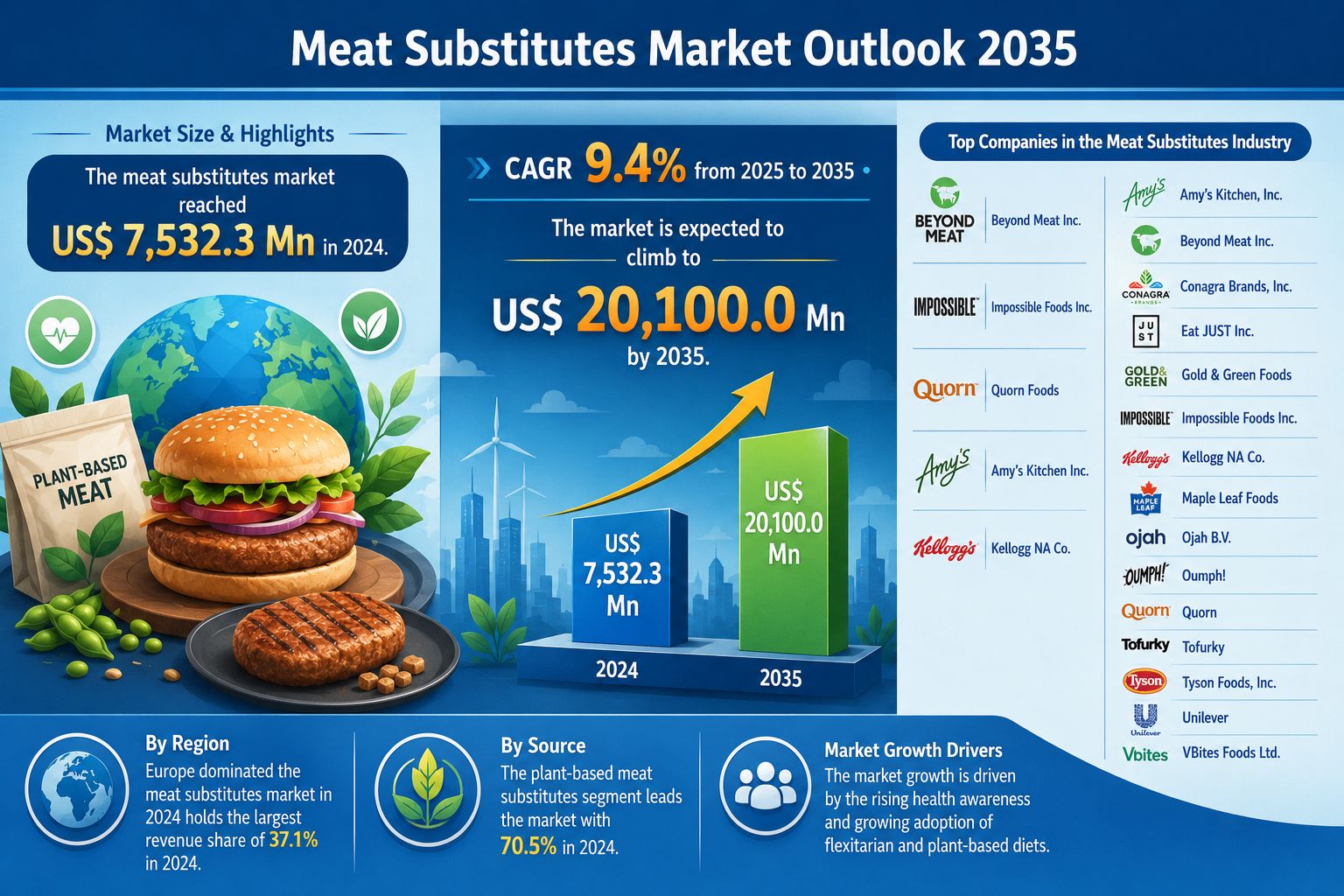
The global Meat Substitutes Market was valued at US$ 7,532.3 Mn in 2024 and is projected to reach US$ 20,100.0 Mn by 2035, expanding at a CAGR of 9.4% from 2025 to 2035, according to the latest market intelligence report. Growing consumer focus on health and wellness, increasing adoption of flexitarian lifestyles, and continuous innovation in plant-based protein technologies are driving significant growth across the global meat substitutes industry.
The market has evolved from a niche category into a mainstream segment of the global food industry. Advancements in flavor enhancement, texture optimization, and protein formulation technologies have substantially improved consumer acceptance of meat alternatives, enabling their integration into everyday diets across multiple demographics.
→Discover Market Opportunities – Request Your Sample Copy Now: https://www.transparencymarketresearch.com/sample/sample.php?flag=S&rep_id=16607
Market Overview
The meat substitutes industry encompasses the development, production, distribution, and commercialization of products designed to replicate the taste, texture, appearance, and nutritional profile of conventional meat while being produced without animal-derived ingredients.
These products are commonly manufactured using protein-rich ingredients such as soy, pea protein, wheat protein (seitan), lentils, chickpeas, beans, rice proteins, and mycoprotein. Emerging technologies including precision fermentation and alternative protein production are also expanding innovation opportunities across the sector.
Meat substitutes are available in diverse formats including burgers, sausages, nuggets, meatballs, mince, strips, and deli slices, catering to both ready-to-cook and ready-to-eat consumer preferences. Distribution channels span supermarkets, hypermarkets, specialty food retailers, online platforms, restaurants, cafés, and institutional foodservice providers.
Analysts’ Viewpoint
Industry analysts note that the meat substitutes market is becoming increasingly organized and commercially mature due to sustained product innovation and expanding consumer acceptance.
Continuous improvements in sensory attributes such as flavor, texture, and appearance have enhanced repeat purchases and broadened consumer appeal beyond traditional vegetarian and vegan populations. The market has also benefited from greater product availability across retail and foodservice channels, creating stronger market penetration and consumer accessibility.
Plant-based meat substitutes continue to dominate the industry owing to established production capabilities, favorable regulatory environments, strong supply chain integration, and extensive technological advancements. Europe remains the leading regional market, supported by mature plant-based food cultures, advanced retail infrastructure, and ongoing innovation activities.
Rising Health Awareness Driving Market Growth
Increasing consumer awareness regarding nutrition and preventive healthcare is one of the most influential factors supporting demand for meat substitutes globally.
Growing concerns over diet-related non-communicable diseases (NCDs), including cardiovascular diseases, diabetes, respiratory illnesses, and certain cancers, have encouraged consumers to seek healthier dietary alternatives. Global health organizations continue to advocate balanced diets with reduced consumption of saturated fats and increased intake of plant-based foods.
As consumers become more informed about nutritional quality, cholesterol content, and overall dietary balance, alternative protein products are increasingly viewed as viable options for maintaining healthier lifestyles. This shift has significantly boosted the acceptance of meat substitutes among health-conscious consumers seeking to reduce their intake of red and processed meat products.
Growing Adoption of Flexitarian and Plant-Based Diets Accelerating Demand
The growing popularity of flexitarian eating patterns is further strengthening market expansion.
Unlike strict vegetarian or vegan lifestyles, flexitarian diets allow occasional meat consumption while emphasizing plant-based food choices. This flexible approach has gained widespread appeal among consumers seeking healthier eating habits without completely eliminating animal products from their diets.
National dietary surveys across developed economies indicate increasing consumer willingness to reduce meat consumption and diversify protein sources. Government-supported nutrition guidelines in several countries now emphasize legumes, pulses, vegetables, and whole grains as important components of balanced diets, fostering greater acceptance of plant-based proteins.
Lifestyle changes, urbanization, and exposure to global food trends have also accelerated consumer adoption of meat substitutes that replicate familiar meat formats while offering perceived health and sustainability benefits.
Plant-Based Meat Substitutes Remain the Dominant Segment
Based on source, the plant-based meat substitutes segment accounted for 70.5% of global market revenue in 2024, making it the largest and most commercially successful category within the alternative protein industry.
The segment’s leadership is attributed to its early commercialization, superior production scalability, and comparatively straightforward regulatory pathway. Plant-based products benefit from established consumer familiarity and broad regulatory acceptance due to their reliance on conventional agricultural ingredients.
Technological advancements in protein texturization, flavor systems, and fat analog development have dramatically improved product quality, contributing to strong consumer retention and repeat purchases.
Widespread adoption across retail chains, quick-service restaurants, and foodservice establishments has further enhanced market visibility and accessibility, strengthening the segment’s dominant market position.
→Explore Strategies & Trends – Request Full Report Access – https://www.transparencymarketresearch.com/sample/sample.php?flag=S&rep_id=16607
Europe Maintains Market Leadership
Europe held the largest share of the global meat substitutes market in 2024, accounting for 37.1% of total revenue.
The region’s leadership is supported by strong consumer acceptance of vegetarian, vegan, and flexitarian diets, particularly in countries such as the United Kingdom, Germany, and the Netherlands. These markets have developed mature plant-based food ecosystems characterized by high consumer awareness and widespread product availability.
Europe also benefits from a well-established regulatory framework that supports plant-based food innovation through transparent food safety standards, sustainability-focused policies, and clear labeling requirements.
Additionally, supermarkets and hypermarkets throughout Europe allocate significant shelf space to meat substitutes, while quick-service restaurants and casual dining establishments increasingly incorporate plant-based menu options, further accelerating consumer adoption.
Competitive Landscape
The global meat substitutes market is characterized by intense competition and ongoing product innovation. Major companies are investing heavily in research and development, product diversification, strategic partnerships, and geographic expansion to strengthen their market positions.
Key companies operating in the market include:
- Amy’s Kitchen, Inc.
- Beyond Meat Inc.
- Conagra Brands, Inc.
- Eat JUST Inc.
- Gold & Green Foods
- Impossible Foods Inc.
- Kellogg NA Co.
- Maple Leaf Foods
- Ojah B.V.
- Oumph!
- Quorn
- Tofurky
- Tyson Foods, Inc.
- Unilever
- VBites Foods Ltd.
Recent Industry Developments
Maple Leaf Foods Expands Alternative Protein Portfolio
In November 2025, Maple Leaf Foods introduced Mighty Protein Meat Sticks, a convenient high-protein snack product designed to meet growing consumer demand for plant-forward nutrition and portable food options.
Beyond Meat Strengthens Retail Presence
In May 2025, Beyond Meat launched Beyond Chicken Pieces across more than 1,900 Kroger stores throughout the United States, significantly expanding its plant-based poultry product portfolio and broadening consumer access to alternative protein solutions.
About the Meat Substitutes Market
The global meat substitutes market is positioned for sustained long-term growth as consumers increasingly prioritize health, nutrition, convenience, and diversified protein consumption. Ongoing innovation in plant-based protein technologies, expanding retail availability, and growing mainstream acceptance of alternative protein products are expected to create substantial opportunities across developed and emerging economies through 2035.
Buy Full Report Now: https://www.transparencymarketresearch.com/checkout.php?rep_id=16607<ype=S
→Explore Latest Research Reports by Transparency Market Research:
Brazil Nut Oil Market: https://www.transparencymarketresearch.com/us-brazil-nut-oil-market.html
Citrus Peels Market: https://www.transparencymarketresearch.com/citrus-peels-market.html
Dried Herbs Market: https://www.transparencymarketresearch.com/dried-herbs-market.html
About Transparency Market Research
Transparency Market Research, a global market research company registered at Wilmington, Delaware, United States, provides custom research and consulting services. Our exclusive blend of quantitative forecasting and trends analysis provides forward-looking insights for thousands of decision makers. Our experienced team of Analysts, Researchers, and Consultants use proprietary data sources and various tools & techniques to gather and analyses information.
Our data repository is continuously updated and revised by a team of research experts, so that it always reflects the latest trends and information. With a broad research and analysis capability, Transparency Market Research employs rigorous primary and secondary research techniques in developing distinctive data sets and research material for business reports.