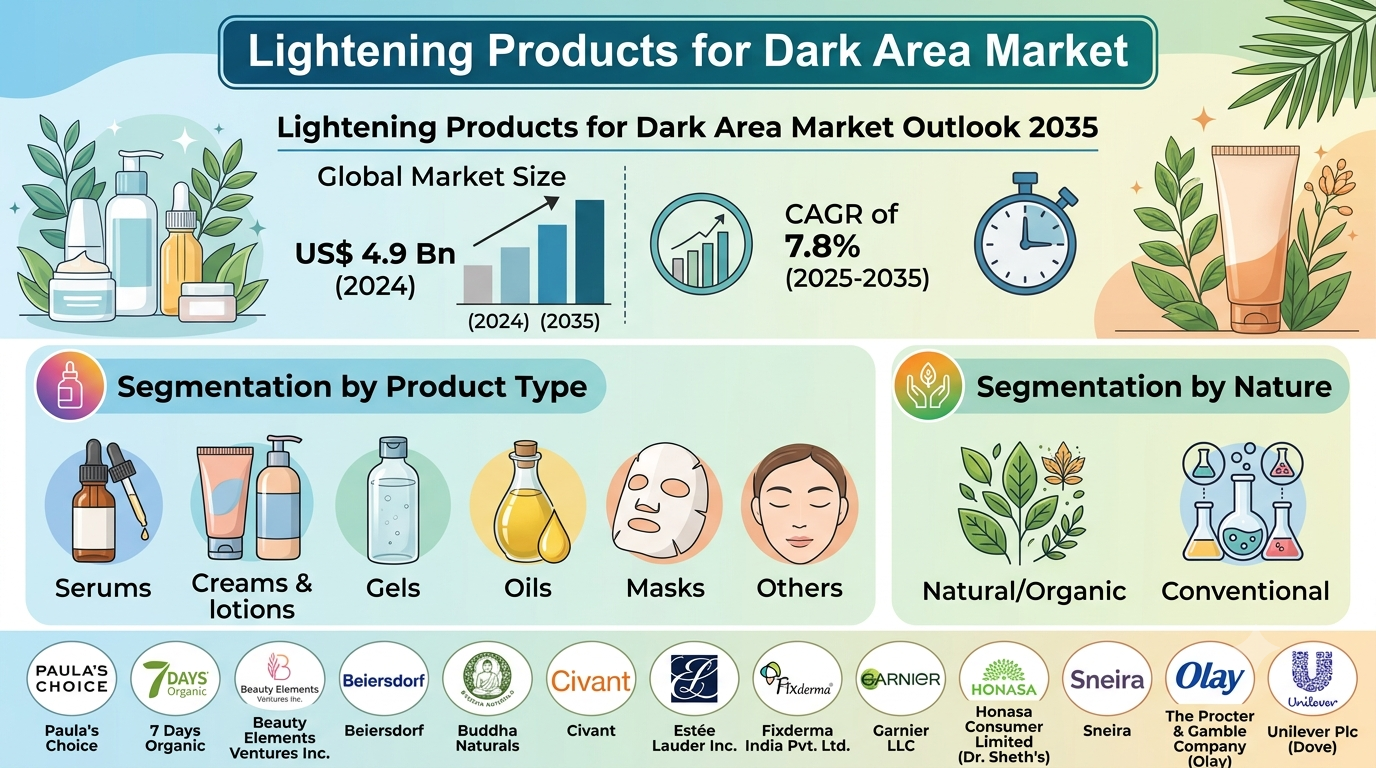
The global Lightening Products for Dark Area Market is witnessing steady expansion as consumers increasingly seek targeted skincare solutions for hyperpigmentation and uneven skin tone. According to the latest industry analysis, the market was valued at US$ 4.9 billion in 2024 and is projected to reach US$ 10.3 billion by 2035, registering a compound annual growth rate (CAGR) of 7.8% during the forecast period from 2025 to 2035. The market continues to benefit from growing awareness of specialized body care, increasing disposable income, expanding beauty and wellness industries, and continuous innovation in dermatologically tested formulations.
Discover essential conclusions and data from our Report in this sample –
https://www.transparencymarketresearch.com/sample/sample.php?flag=S&rep_id=86902
Market Overview
The lightening products for dark area market has evolved into a specialized segment within the global skincare industry, addressing localized hyperpigmentation affecting underarms, knees, elbows, inner thighs, neck, and intimate areas. Consumers are increasingly adopting products formulated with ingredients such as niacinamide, kojic acid, alpha arbutin, vitamin C derivatives, botanical extracts, and lactic acid to achieve gradual and safer skin tone correction.
Manufacturers are emphasizing gentle formulations suitable for sensitive skin while complying with evolving cosmetic regulations worldwide. Growing consumer awareness regarding ingredient transparency, dermatologist-tested formulations, and long-term skin health has significantly shifted purchasing preferences toward clinically validated products. Moreover, the rapid expansion of online retail channels has enabled brands to reach broader customer bases while educating consumers about proper product usage and realistic expectations.
Key Market Growth Drivers
One of the primary growth drivers is the increasing awareness surrounding intimate skincare and body pigmentation management. Consumers today are more informed about pigmentation caused by friction, hormonal changes, shaving, aging, and sun exposure. Educational initiatives by dermatologists and beauty professionals have reduced stigma associated with discussing these concerns, encouraging broader product adoption among both women and men.
The expanding aesthetic treatment industry is another significant factor supporting market growth. Professional treatments such as chemical peels, laser toning, and skin rejuvenation procedures often require complementary topical skincare products, creating sustained demand for lightening creams, serums, and lotions designed for post-treatment maintenance.
Social media platforms, beauty influencers, and digital marketing campaigns continue to shape consumer purchasing decisions by promoting skincare routines focused on overall body care rather than facial care alone. Additionally, product innovation centered on plant-based ingredients, fragrance-free formulations, and skin barrier protection has strengthened consumer confidence while attracting health-conscious buyers seeking safer alternatives.
Growing urbanization, rising disposable incomes, and increasing investments in premium skincare products across developing economies are further contributing to sustained market expansion over the forecast period.
Analysis of Key Players – Key Player Strategies
The competitive landscape is characterized by continuous product innovation, strategic collaborations, premium product launches, and expanding retail presence. Leading companies including Estée Lauder Inc., Unilever Plc (Dove), The Procter & Gamble Company (Olay), Beiersdorf, Garnier LLC, Paula’s Choice, Fixderma India Pvt. Ltd., Honasa Consumer Limited (Dr. Sheth’s), Civant, Buddha Naturals, Beauty Elements Ventures Inc., Sneira, and 7 Days Organic continue strengthening their market positions through diversified product portfolios and research-driven product development.
Manufacturers are increasingly investing in scientifically backed active ingredients that deliver gradual skin brightening while minimizing irritation risks. Clinical testing, dermatologist endorsements, and transparent ingredient labeling have become central components of brand positioning strategies.
Companies are also strengthening their digital presence through direct-to-consumer platforms, influencer partnerships, and personalized skincare recommendations. Simultaneously, collaborations with pharmacies, supermarkets, specialty beauty retailers, and aesthetic clinics have expanded product accessibility across both developed and emerging markets. Continuous investments in sustainable packaging, environmentally responsible sourcing, and cruelty-free formulations are further enhancing brand value among environmentally conscious consumers.
Market Challenges & Opportunities
Despite promising growth prospects, the market continues to face several challenges. Regulatory scrutiny surrounding cosmetic claims, product safety, and prohibited skin-lightening ingredients remains one of the most significant barriers for manufacturers operating across multiple regions. Companies must continuously reformulate products to comply with varying international regulations while maintaining product effectiveness.
Consumer misconceptions regarding skin lightening products also present reputational challenges, requiring manufacturers to emphasize skin tone correction and hyperpigmentation management rather than unrealistic whitening claims. Furthermore, increasing competition from counterfeit products and low-cost alternatives may affect premium brand performance in price-sensitive markets.
However, substantial opportunities continue to emerge. Growing demand for clean-label, natural, and organic skincare formulations presents considerable expansion potential. Increasing male grooming trends, expanding dermatology clinics, personalized skincare solutions, and advanced cosmetic research are expected to generate new revenue streams. Rising adoption of AI-based skincare diagnostics and customized beauty solutions is also expected to create future opportunities for product personalization.
Key Player Strategies
Industry participants are focusing heavily on innovation, clinical validation, and consumer education to strengthen long-term market competitiveness. Companies are expanding research activities aimed at combining multiple active ingredients that provide effective pigmentation correction while preserving skin barrier function.
Strategic acquisitions, product portfolio diversification, and geographic expansion remain major priorities among global manufacturers. Businesses are also investing in premium packaging formats including roll-ons, droppers, and travel-friendly tubes that improve product convenience and consumer experience. Educational campaigns highlighting safe application practices, dermatologist guidance, and evidence-based efficacy are increasingly becoming essential marketing strategies to build long-term consumer trust.
Investment Landscape and ROI Outlook
Investment activity within the lightening products for dark area market remains highly favorable as global demand for specialized skincare products continues to increase. Investors are showing growing interest in companies developing premium formulations supported by clinical evidence, sustainable sourcing practices, and innovative delivery technologies.
The rapid expansion of e-commerce, digital beauty platforms, and direct-to-consumer sales models is improving profit margins while reducing dependence on conventional retail distribution. Emerging economies across Asia Pacific, Latin America, and the Middle East offer attractive investment opportunities due to rising consumer spending, expanding middle-class populations, and increasing skincare awareness.
Long-term return on investment is expected to remain strong as manufacturers continue introducing differentiated products targeting specific body areas and skin concerns. Investments in research, advanced formulation technologies, and regulatory compliance are likely to provide sustainable competitive advantages throughout the forecast period.
Market Segmentations (with Region)
The global lightening products for dark area market is segmented by product type into serums, creams & lotions, gels, oils, masks, and others, with creams and lotions accounting for the largest market share of 38.5% in 2024 due to their ease of application, moisturizing properties, and widespread consumer acceptance.
Based on nature, the market is categorized into natural/organic products and conventional formulations as demand continues to shift toward botanical and clean-label ingredients. By target body area, products are developed for underarms, inner thighs, intimate areas and buttocks, knees and elbows, neck, and other pigmentation-prone areas. Gender segmentation includes products designed for women and an expanding portfolio targeting male consumers. Packaging formats include tubes, bottles, droppers, roll-ons, jars, and sachets, while distribution channels comprise online platforms through company-owned websites and e-commerce marketplaces alongside offline sales via supermarkets, specialty stores, pharmacies, convenience stores, and department stores.
Regionally, Asia Pacific dominated the global market in 2024 with a 47.3% revenue share, supported by strong skincare traditions, growing consumer awareness, large population base, and advanced manufacturing capabilities. North America continues to demonstrate significant growth driven by premium skincare adoption and dermatologist-recommended products. Europe maintains a strong market presence through strict regulatory compliance and high consumer demand for clean beauty formulations, while Latin America and the Middle East & Africa are emerging as attractive growth markets supported by increasing urbanization and rising disposable incomes.
Why Buy This Report?
This comprehensive market report delivers detailed insights into current industry trends, market size, future growth forecasts, competitive benchmarking, technological developments, regulatory landscape, investment opportunities, and regional market dynamics. It provides extensive company profiling, strategic analysis, segmentation by product, nature, body area, packaging, gender, distribution channel, and geography, enabling stakeholders to make informed business decisions. The report also offers valuable intelligence on emerging consumer preferences, innovation strategies, and future market opportunities that can support long-term strategic planning and investment decisions.
FAQs
What is the projected size of the global lightening products for dark area market by 2035?
The market is projected to reach US$ 10.3 billion by 2035, growing from US$ 4.9 billion in 2024.
What is driving the growth of the lightening products for dark area market?
Major growth drivers include increasing awareness of hyperpigmentation treatments, rising demand for intimate skincare, expanding aesthetic procedures, product innovation, and growing consumer preference for dermatologist-tested formulations.
Which region dominates the global market?
Asia Pacific led the global market in 2024, accounting for 47.3% of total revenue due to strong skincare culture, large consumer base, and advanced cosmetic manufacturing capabilities.
Which product segment holds the largest market share?
Creams and lotions represented the largest product segment with a 38.5% market share in 2024, supported by high consumer acceptance and suitability for sensitive skin.
Who are the major companies operating in the global lightening products for dark area market?
Leading market participants include Estée Lauder Inc., Unilever Plc (Dove), The Procter & Gamble Company (Olay), Beiersdorf, Garnier LLC, Paula’s Choice, Fixderma India Pvt. Ltd., Honasa Consumer Limited (Dr. Sheth’s), Civant, Buddha Naturals, Beauty Elements Ventures Inc., Sneira, and 7 Days Organic.