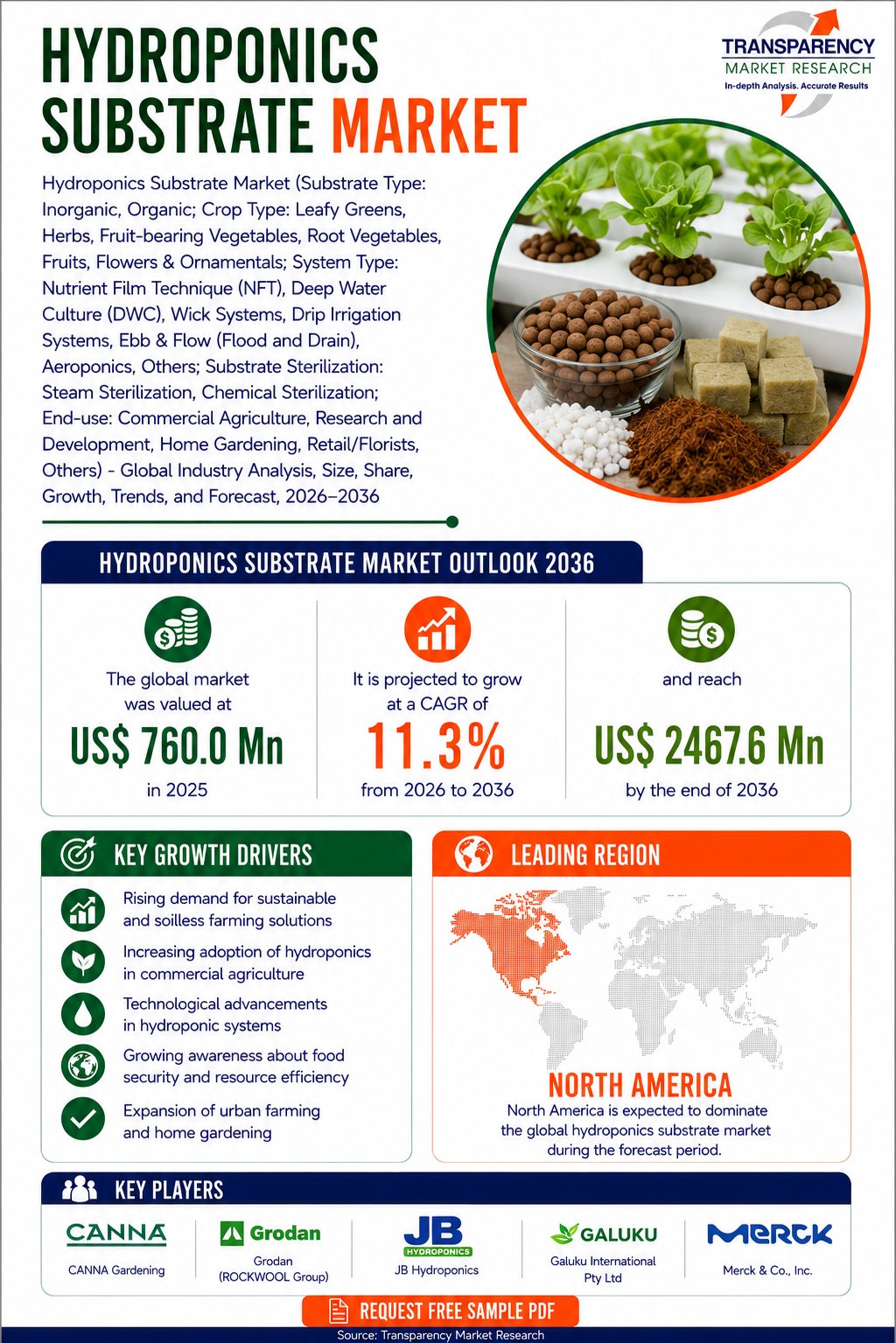
The global hydroponics substrate market is witnessing robust expansion driven by the rising adoption of sustainable agriculture practices and increasing investments in controlled-environment agriculture (CEA). According to industry analysis, the hydroponics substrate market was valued at US$ 760.0 million in 2025 and is projected to reach US$ 2467.6 million by 2036, expanding at a CAGR of 11.3% during the forecast period from 2026 to 2036.
Hydroponic substrates are essential growing media used in soil-less farming systems to support plant roots, regulate moisture, improve aeration, and enhance nutrient delivery. Materials such as coco coir, rock wool, perlite, vermiculite, peat moss, and clay pebbles are increasingly being used across greenhouse farming, indoor farming, and vertical agriculture applications.
As climate change, urbanization, water scarcity, and declining arable land continue to impact traditional agriculture, hydroponic cultivation systems are emerging as reliable and resource-efficient alternatives for crop production. Hydroponic substrates play a vital role in enabling growers to achieve higher yields, shorter crop cycles, and year-round production.
North America dominated the global market in 2025, accounting for 41.9% of the total market share, supported by strong investments in vertical farming and advanced greenhouse technologies.
Access important conclusions and data points from our Report in this sample – https://www.transparencymarketresearch.com/sample/sample.php?flag=S&rep_id=33752
Key Drivers of Market Growth
Expansion of Controlled-Environment Agriculture (CEA)
One of the primary growth drivers for the hydroponics substrate market is the rapid expansion of controlled-environment agriculture. Commercial greenhouse operators and vertical farming companies are increasingly shifting toward hydroponic systems to improve crop consistency and optimize resource utilization.
Hydroponic substrates provide stable root-zone conditions, allowing precise control over moisture, aeration, and nutrient availability. This precision is especially important for high-value crops such as leafy greens, tomatoes, herbs, strawberries, cucumbers, and peppers.
The rise of urban farming projects and indoor agriculture facilities is further accelerating substrate demand, particularly in densely populated cities where conventional farming space is limited.
Rising Demand for Sustainable Farming
The global agriculture sector is increasingly focusing on sustainability and resource conservation. Hydroponic systems use significantly less water compared to traditional soil farming and enable efficient nutrient management with reduced chemical runoff.
This shift toward environmentally responsible farming practices is driving demand for eco-friendly and biodegradable substrates such as coco coir and renewable organic media. Manufacturers are also investing in recycling initiatives and sustainable production techniques to reduce environmental impact.
Increasing Food Security Concerns
Governments and agribusiness organizations worldwide are prioritizing food security and local food production. Hydroponics enables year-round crop cultivation independent of climatic conditions, making it a preferred solution for regions facing unpredictable weather patterns and shrinking arable land.
As global populations continue to rise, hydroponic farming systems supported by high-performance substrates are expected to play a major role in future food production strategies.
Key Players and Industry Leaders
The hydroponics substrate market is moderately consolidated with several established global and regional manufacturers competing through innovation, sustainability initiatives, and strategic partnerships.
Major companies operating in the market include:
- CANNA Gardening
- Grodan (ROCKWOOL Group)
- JB Hydroponics
- Galuku International Pty Ltd
- Nutrifield Pty Ltd
- BVB Substrates
- Pelemix Ltd
- Termolita
- Projar
- HydroGarden Ltd
- Botanicare
- General Hydroponics
- Royal Gold LLC
- Gold Label
- FoxFarm
- Biobizz
- Smithers Oasis
- Nordic Substrate Solutions
These companies are actively developing advanced hydroponic substrates with improved water retention, nutrient buffering capacity, low EC levels, and pathogen-free characteristics to meet the evolving needs of commercial growers.
Recent Developments
The hydroponics substrate industry has witnessed several strategic developments aimed at strengthening product portfolios and improving operational efficiency.
Pelemix Expands Global Presence
In December 2025, Pelemix partnered with Sun Gro Horticulture to supply coir-based hydroponic substrates across Europe, Asia, and Africa. The partnership is expected to improve product standardization and supply chain reliability for commercial greenhouse growers.
Pelemix Invests in Raw Material Processing
In September 2025, Pelemix established a coconut husk processing and drying facility in Sri Lanka. The move strengthens the company’s upstream control over raw material quality while enhancing traceability and consistency in substrate production.
Grodan and Hoogendoorn Strategic Collaboration
In July 2025, Grodan announced a strategic partnership with Hoogendoorn Growth Management to integrate GroSens root-zone sensor technology into the IIVO climate platform. The collaboration enables real-time monitoring of greenhouse conditions and supports precision irrigation management.
OASIS Grower Solutions Launches Aerostar™
In March 2024, OASIS Grower Solutions introduced the Aerostar™ family of precision hydroponic substrates featuring advanced porous matrix technology designed to optimize water and air movement within controlled-environment systems.
New Opportunities and Challenges
Opportunities
The growing commercial adoption of soil-less cultivation systems presents substantial opportunities for substrate manufacturers. Large-scale greenhouse operations, vertical farms, and urban agriculture projects require reliable, scalable, and high-performance growing media.
Demand for premium substrates tailored for specific crops and growing systems is expected to increase significantly over the next decade.
In addition, the emergence of smart agriculture technologies and data-driven farming solutions is opening new possibilities for integrated substrate systems with sensor compatibility and automated nutrient management.
Challenges
Despite strong growth prospects, the industry faces several challenges:
- High initial investment costs for hydroponic infrastructure
- Supply chain fluctuations in raw materials such as coco coir
- Disposal and recycling concerns related to synthetic substrates
- Limited awareness among small-scale farmers in developing regions
- Need for technical expertise in managing hydroponic systems
Addressing these challenges through innovation, training programs, and sustainable manufacturing practices will be crucial for long-term market expansion.
Market Trends & Innovations
Growing Popularity of Rock Wool Substrates
Rock wool remains the leading inorganic substrate segment, accounting for 38.7% of market share in 2025. Its superior moisture retention, aeration capabilities, and sterile composition make it ideal for commercial hydroponic applications.
Shift Toward Biodegradable Substrates
Environmental concerns are encouraging the development of biodegradable and renewable growing media. Coco coir, wood fibers, and organic blends are gaining traction due to their lower environmental footprint.
Integration with Precision Agriculture
Advanced sensors and digital monitoring systems are increasingly being integrated with hydroponic substrates to optimize irrigation, nutrient delivery, and root-zone conditions in real time.
Vertical Farming Expansion
The rapid growth of vertical farming is creating strong demand for lightweight, high-efficiency substrates compatible with stacked growing systems and automated farming technologies.
Buy this Premium Research Report for exclusive, in-depth insights – https://www.transparencymarketresearch.com/checkout.php?rep_id=33752<ype=S
Future Outlook
The future of the hydroponics substrate market appears highly promising as sustainable agriculture transitions from a niche concept to a mainstream food production strategy.
Growing urban populations, increasing food demand, and climate-related agricultural challenges will continue to accelerate the adoption of hydroponic cultivation systems worldwide.
Manufacturers are expected to focus on:
- Sustainable and recyclable substrate solutions
- Smart substrate technologies integrated with IoT systems
- Customized media for crop-specific applications
- Improved logistics and supply chain efficiency
- Expansion into emerging markets across Asia Pacific, Latin America, and the Middle East
North America is expected to maintain its market leadership position, while Asia Pacific is projected to witness the fastest growth due to rising investments in indoor farming and government support for sustainable agriculture initiatives.
Market Segmentation
By Substrate Type
- Inorganic
- Coco Coir
- Perlite
- Vermiculite
- Clay Pebbles
- Rock Wool
- Pumice
- Others
- Organic
- Peat Moss
- Bark
- Sawdust
- Rice Hulls
- Others
By Crop Type
- Leafy Greens
- Herbs
- Fruit-bearing Vegetables
- Root Vegetables
- Fruits
- Flowers & Ornamentals
By System Type
- Nutrient Film Technique (NFT)
- Deep Water Culture (DWC)
- Wick Systems
- Drip Irrigation Systems
- Ebb & Flow Systems
- Aeroponics
- Others
By Substrate Sterilization
- Steam Sterilization
- Chemical Sterilization
By End-use
- Commercial Agriculture
- Research and Development
- Home Gardening
- Retail/Florists
- Others
By Region
- North America
- Europe
- Asia Pacific
- Latin America
- Middle East & Africa
Key Trends for the Future
Several emerging trends are expected to shape the future of the hydroponics substrate market:
- Expansion of AI-driven hydroponic farming systems
- Increased use of renewable and circular-economy substrate materials
- Greater adoption of urban vertical farms
- Rising investment in greenhouse automation technologies
- Demand for pathogen-free and sterile growing media
- Integration of substrate analytics and smart sensors
- Growth of localized food production systems
These trends are likely to redefine modern agriculture and strengthen the role of hydroponic substrates in sustainable food production.
Important FAQs with Answers
What is the current size of the hydroponics substrate market?
The global hydroponics substrate market was valued at US$ 760.0 million in 2025.
What is the projected market value by 2036?
The market is expected to reach US$ 2467.6 million by 2036.
What is driving the growth of the hydroponics substrate industry?
Major growth drivers include the expansion of controlled-environment agriculture, rising demand for sustainable farming, increasing food security concerns, and rapid adoption of vertical farming systems.
Which region dominates the market?
North America held the largest market share of 41.9% in 2025.
Which substrate type leads the market?
Rock wool is the leading substrate type, accounting for 38.7% of the market share in 2025.
What are the most commonly used hydroponic substrates?
Common substrates include coco coir, rock wool, perlite, vermiculite, peat moss, and clay pebbles.
Which crops are widely grown using hydroponic substrates?
Leafy greens, herbs, tomatoes, peppers, cucumbers, strawberries, and ornamental plants are among the most commonly cultivated hydroponic crops.
Who are the major market players?
Leading companies include CANNA Gardening, Grodan (ROCKWOOL Group), JB Hydroponics, Galuku International Pty Ltd, and Nutrifield Pty Ltd.
More Related Reports –
Hot-rolled Steel Coil Market: https://www.transparencymarketresearch.com/hotrolled-steel-coil-market.html
Polycarbonate Diols Market: https://www.transparencymarketresearch.com/polycarbonate-diols-market.html
Fungicides Market: https://www.transparencymarketresearch.com/fungicides-market.html
Asphalt Additives Market: https://www.transparencymarketresearch.com/asphalt-additives-market.html
About Us Transparency Market Research
Transparency Market Research, a global market research company registered at Wilmington, Delaware, United States, provides custom research and consulting services. The firm scrutinizes factors shaping the dynamics of demand in various markets. The insights and perspectives on the markets evaluate opportunities in various segments. The opportunities in the segments based on source, application, demographics, sales channel, and end-use are analysed, which will determine growth in the markets over the next decade.
Our exclusive blend of quantitative forecasting and trends analysis provides forward-looking insights for thousands of decision-makers, made possible by experienced teams of Analysts, Researchers, and Consultants. The proprietary data sources and various tools & techniques we use always reflect the latest trends and information. With a broad research and analysis capability, Transparency Market Research employs rigorous primary and secondary research techniques in all of its business reports.
Contact:
Abhishek Budholiya
Transparency Market Research Inc.
State Tower, 90 State Street, Suite 700,
Albany NY – 12207, United States
Tel: +1-518-618-1030
USA – Canada Toll Free: 866-552-3453
Website: https://www.transparencymarketresearch.com
Media Inquiries: media@transparencymarketresearch.com
Sales Inquiries: sales@transparencymarketresearch.com