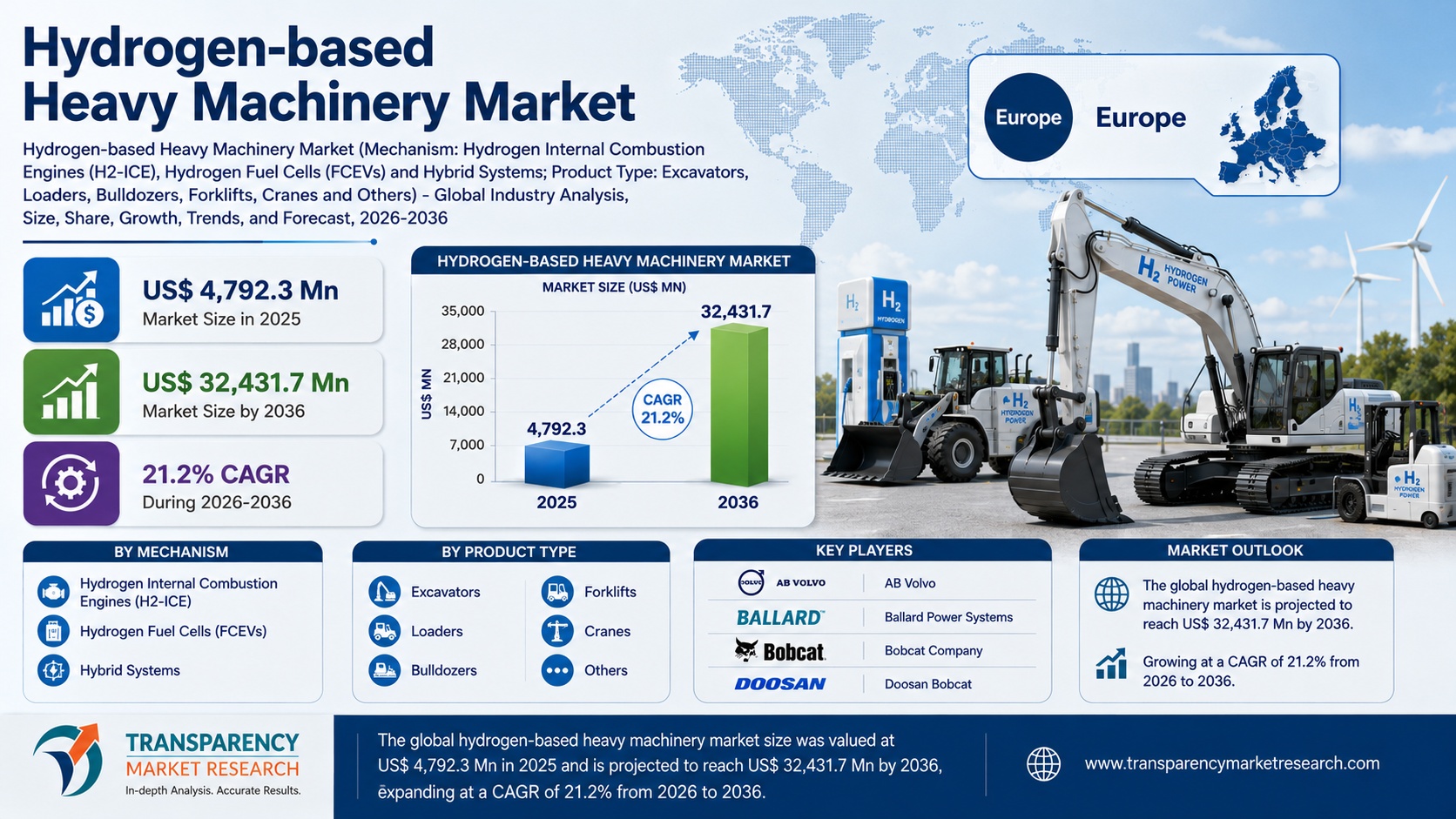
The global hydrogen-based heavy machinery market is entering a transformative phase as industries seek sustainable alternatives to diesel-powered equipment. According to recent market research, the global hydrogen-based heavy machinery market was valued at US$ 4,792.3 million in 2025 and is projected to reach US$ 32,431.7 million by 2036, registering a robust CAGR of 21.2% from 2026 to 2036.
Hydrogen-powered heavy machinery includes a wide range of industrial equipment such as excavators, loaders, bulldozers, forklifts, cranes, dump trucks, mining vehicles, and agricultural machinery powered by hydrogen fuel cells, hydrogen internal combustion engines (H2-ICE), or hybrid systems. These machines offer a cleaner alternative to conventional diesel equipment while maintaining the high power output and operational efficiency required for demanding industrial applications.
The market is gaining momentum as governments, industrial operators, and equipment manufacturers prioritize carbon reduction initiatives and invest heavily in clean-energy technologies. Hydrogen-based heavy machinery is emerging as a practical solution for industries seeking to balance sustainability goals with operational productivity.
Explore the highlights and essential data from our Report in this sample – https://www.transparencymarketresearch.com/sample/sample.php?flag=S&rep_id=86919
Market Overview: Hydrogen-based heavy machinery represents one of the most promising developments in the industrial equipment sector. Unlike traditional diesel-powered machines that generate significant greenhouse gas emissions, hydrogen-powered equipment can operate with little to no carbon emissions, depending on the technology used.
The market encompasses not only machinery but also supporting infrastructure such as hydrogen storage systems, fuel cell stacks, hydrogen tanks, power management systems, and refueling stations. As hydrogen production technologies continue to mature and green hydrogen becomes more widely available, adoption of hydrogen-powered industrial equipment is expected to accelerate significantly.
One of the key advantages of hydrogen-powered machinery is its ability to deliver high energy output while offering rapid refueling times and long operating ranges. These capabilities make hydrogen particularly attractive for industries such as construction, mining, agriculture, logistics, and port operations where equipment must operate continuously under challenging conditions.
The market is also benefiting from increasing investments in hydrogen ecosystems, including production facilities, transportation networks, and refueling infrastructure. Such developments are creating a favorable environment for widespread adoption of hydrogen-powered machinery.
Key Drivers of Market Growth
Rising Demand for Sustainable Industrial Operations
The growing emphasis on sustainability is a major factor driving the hydrogen-based heavy machinery market. Industries across the globe are under pressure to reduce emissions and comply with increasingly stringent environmental regulations.
Construction, mining, logistics, and industrial manufacturing sectors are among the largest contributors to carbon emissions. Governments are introducing stricter policies aimed at reducing industrial pollution, prompting companies to adopt cleaner technologies.
Hydrogen-powered machinery provides a viable solution by enabling operators to significantly reduce emissions without compromising productivity. As organizations pursue net-zero targets and sustainability commitments, demand for hydrogen-based equipment is expected to increase substantially.
Growing awareness regarding climate change and environmental responsibility is also encouraging businesses to invest in low-emission machinery capable of supporting long-term sustainability goals.
Limitations of Battery-Electric Heavy Equipment
Although battery-electric technologies have gained popularity in passenger vehicles and light-duty equipment, they face considerable challenges in heavy-duty industrial applications.
Heavy machinery often operates for extended periods in remote locations where charging infrastructure may be limited or unavailable. Long charging times, reduced operating range, and infrastructure requirements can negatively impact productivity and operational efficiency.
Construction sites, mining operations, and industrial facilities frequently require machinery to operate continuously for 8 to 12 hours or longer. Battery-electric systems may struggle to meet these demands without significant downtime for recharging.
Hydrogen-powered machinery addresses these limitations through rapid refueling capabilities, higher energy density, and longer operating ranges. These advantages make hydrogen particularly suitable for demanding industrial environments where uninterrupted operation is essential.
Expansion of Global Hydrogen Economy
The growing global hydrogen economy is creating new opportunities for the heavy machinery sector. Investments in hydrogen production, transportation, storage, and distribution infrastructure are increasing rapidly across major economies.
Many countries have introduced national hydrogen strategies aimed at promoting clean hydrogen production and supporting industrial decarbonization efforts. These initiatives are improving hydrogen availability while reducing fuel costs.
As hydrogen infrastructure expands, barriers to adoption are expected to decline, making hydrogen-powered machinery more accessible to industrial operators worldwide.
Key Players and Industry Leaders
The hydrogen-based heavy machinery market features several prominent equipment manufacturers, hydrogen technology providers, and industrial engineering companies actively investing in innovation and commercialization.
Major companies operating in the market include:
- AB Volvo
- Ballard Power Systems
- Bobcat Company
- Doosan Bobcat
- HD Hyundai Construction Equipment Co., Ltd.
- Hitachi Construction Machinery
- JC Bamford Excavators Ltd. (JCB)
- Kobelco Construction Machinery Co., Ltd.
- Komatsu Ltd.
- Liebherr
- PACCAR Inc.
- Plug Power Inc.
- Sumitomo Construction Machinery Co., Ltd.
- Toyota Motor Corporation
- XCMG Group
These companies are investing heavily in research and development activities focused on hydrogen fuel cells, hydrogen combustion engines, hybrid systems, and advanced energy management technologies.
Strategic collaborations among equipment manufacturers, hydrogen suppliers, and technology developers are accelerating innovation and supporting commercial deployment across multiple industries.
Recent Developments
Hitachi Energy Launches HyFlex Hydrogen Generator
In July 2025, Hitachi Energy introduced its HyFlex hydrogen generator at a construction site in the Netherlands. The generator was used to provide clean energy for a battery-electric excavator, demonstrating the potential of hydrogen-powered solutions in construction applications.
This development highlights the growing integration of hydrogen technologies within industrial equipment ecosystems and showcases the role hydrogen can play in supporting sustainable construction practices.
Hyster Receives Innovation Recognition
In April 2025, Hyster Company’s hydrogen fuel cell-powered ReachStacker received recognition at the 2025 BIG Innovation Awards.
The machine demonstrated exceptional performance in pilot applications involving port container handling operations. Key benefits included extended operating times, rapid refueling capabilities, and reliable heavy-duty performance.
Such achievements reinforce the commercial viability of hydrogen-powered machinery and highlight growing industry confidence in hydrogen technologies.
Key Trends for the Future
Growth of Hydrogen Internal Combustion Engine Technology
Hydrogen Internal Combustion Engines (H2-ICE) currently represent the leading technology segment in the market, accounting for 46.8% of market share in 2025.
The popularity of H2-ICE technology stems from its compatibility with existing engine platforms. Manufacturers can adapt conventional diesel engines for hydrogen use with relatively minor modifications, reducing development costs and accelerating commercialization.
This approach enables equipment manufacturers to leverage existing production capabilities while delivering low-emission solutions to customers.
Expansion of Green Hydrogen Production
Green hydrogen produced using renewable energy sources is expected to become increasingly important in the coming years.
As renewable electricity generation expands and electrolysis technologies improve, green hydrogen production costs are expected to decline significantly. This will enhance the environmental and economic attractiveness of hydrogen-powered machinery.
The availability of affordable green hydrogen will play a critical role in supporting widespread adoption across industrial sectors.
Digitalization and Smart Machinery
Digital technologies are becoming increasingly integrated into hydrogen-powered machinery.
Advanced telematics systems, predictive maintenance tools, and energy management platforms enable operators to optimize equipment performance, reduce operating costs, and improve reliability.
The combination of hydrogen propulsion and digital intelligence is expected to create highly efficient and sustainable industrial equipment solutions.
New Opportunities and Challenges
Emerging Opportunities
The hydrogen-based heavy machinery market presents substantial growth opportunities across several industries.
Key opportunity areas include:
- Construction and infrastructure development
- Mining and resource extraction
- Industrial yard operations
- Port and terminal equipment
- Agriculture and farming
- Material handling and warehousing
- Rail and industrial transport
Rapid urbanization, infrastructure investments, and industrial expansion in emerging economies are expected to generate additional demand for hydrogen-powered equipment.
The growing adoption of hydrogen technologies in industrial applications is also creating opportunities for fuel suppliers, infrastructure providers, and technology developers.
Market Challenges
Despite strong growth prospects, several challenges remain.
Hydrogen infrastructure development remains uneven across regions, limiting adoption in certain markets. Establishing hydrogen production facilities, transportation networks, and refueling stations requires substantial investment.
High initial equipment costs also pose challenges for some operators. Although long-term operational benefits may offset upfront expenses, adoption may be slower among smaller businesses.
Additionally, safety standards, regulatory frameworks, and supply chain development must continue evolving to support large-scale commercialization.
Addressing these challenges will be essential for achieving sustained market growth.
Buy this Premium Research Report for a comprehensive view of market dynamics – https://www.transparencymarketresearch.com/checkout.php?rep_id=86919<ype=S
Market Trends & Innovations
Dominance of H2-ICE Technology
Hydrogen Internal Combustion Engine technology continues to dominate the market due to its durability, affordability, and compatibility with existing equipment designs.
The technology offers:
- High torque output
- Excellent durability
- Fast refueling
- Lower development costs
- Proven reliability
- Scalability for heavy-duty applications
These characteristics make H2-ICE systems particularly attractive for construction, mining, and agricultural equipment.
Advancements in Fuel Cell Systems
Hydrogen fuel cell technology is also progressing rapidly. Manufacturers are developing more durable, efficient, and compact fuel cell systems specifically designed for heavy-duty applications.
Fuel cells offer zero tailpipe emissions and high efficiency, making them an attractive option for operators seeking maximum environmental benefits.
Development of Hydrogen Infrastructure
The expansion of hydrogen refueling networks is helping improve the practicality of hydrogen-powered machinery.
Governments and private-sector investors are funding hydrogen corridors, industrial hydrogen hubs, and refueling stations that support heavy-duty transportation and industrial operations.
This infrastructure development is expected to accelerate market adoption over the forecast period.
Market Segmentation
By Mechanism
- Hydrogen Internal Combustion Engines (H2-ICE)
- Hydrogen Fuel Cells (FCEVs)
- Hybrid Systems
By Product Type
- Excavators
- Loaders
- Bulldozers
- Forklifts
- Cranes
- Others
By Power
- Up to 50 kW
- 50–200 kW
- Above 200 kW
By Operation
- Manual
- Semi-Automatic/Fully Automatic
By Application
- Construction & Infrastructure
- Mining & Resource Extraction
- Industrial Yard/Port Operations
- Agriculture & Farming
- Material Handling & Warehousing
- Others
By Distribution Channel
- Direct Sales
- Indirect Sales
Important FAQs with Answers
What was the market size in 2025?
The global hydrogen-based heavy machinery market was valued at US$ 4,792.3 million in 2025.
What is the projected market value by 2036?
The market is expected to reach US$ 32,431.7 million by 2036.
What is the forecast CAGR?
The market is projected to grow at a CAGR of 21.2% between 2026 and 2036.
What is driving market growth?
Key drivers include rising demand for sustainable industrial operations and the limitations of battery-electric heavy equipment.
Which mechanism segment dominates the market?
Hydrogen Internal Combustion Engines (H2-ICE) lead the market with a 46.8% share.
Who are the leading companies in the market?
Major players include Komatsu, Hitachi Construction Machinery, HD Hyundai Construction Equipment, Ballard Power Systems, Volvo, Liebherr, Toyota Motor Corporation, Plug Power, and XCMG Group.
More Related Reports –
Isostatic Pressing Market: https://www.transparencymarketresearch.com/isostatic-pressing-market.html
Sedimentation Centrifuge Market: https://www.transparencymarketresearch.com/sedimentation-centrifugation-market.html
Electric Boiler Market: https://www.transparencymarketresearch.com/electric-boiler-market.html
Pick and Place Machines Market: https://www.transparencymarketresearch.com/pick-and-place-machines-market.html
About Us Transparency Market Research
Transparency Market Research, a global market research company registered at Wilmington, Delaware, United States, provides custom research and consulting services. The firm scrutinizes factors shaping the dynamics of demand in various markets. The insights and perspectives on the markets evaluate opportunities in various segments. The opportunities in the segments based on source, application, demographics, sales channel, and end-use are analysed, which will determine growth in the markets over the next decade.
Our exclusive blend of quantitative forecasting and trends analysis provides forward-looking insights for thousands of decision-makers, made possible by experienced teams of Analysts, Researchers, and Consultants. The proprietary data sources and various tools & techniques we use always reflect the latest trends and information. With a broad research and analysis capability, Transparency Market Research employs rigorous primary and secondary research techniques in all of its business reports.
Contact:
Abhishek Budholiya
Transparency Market Research Inc.
State Tower, 90 State Street, Suite 700,
Albany NY – 12207, United States
Tel: +1-518-618-1030
USA – Canada Toll Free: 866-552-3453
Website: https://www.transparencymarketresearch.com
Media Inquiries: media@transparencymarketresearch.com
Sales Inquiries: sales@transparencymarketresearch.com