The global Hybrid Electric Vehicle (HEV) Market is witnessing robust expansion as consumers increasingly seek fuel-efficient, low-emission transportation solutions without compromising driving range and convenience. Rising fuel prices, stringent environmental regulations, growing climate awareness, and continuous improvements in hybrid powertrain technology are encouraging widespread adoption of hybrid electric vehicles across passenger and commercial transportation sectors.
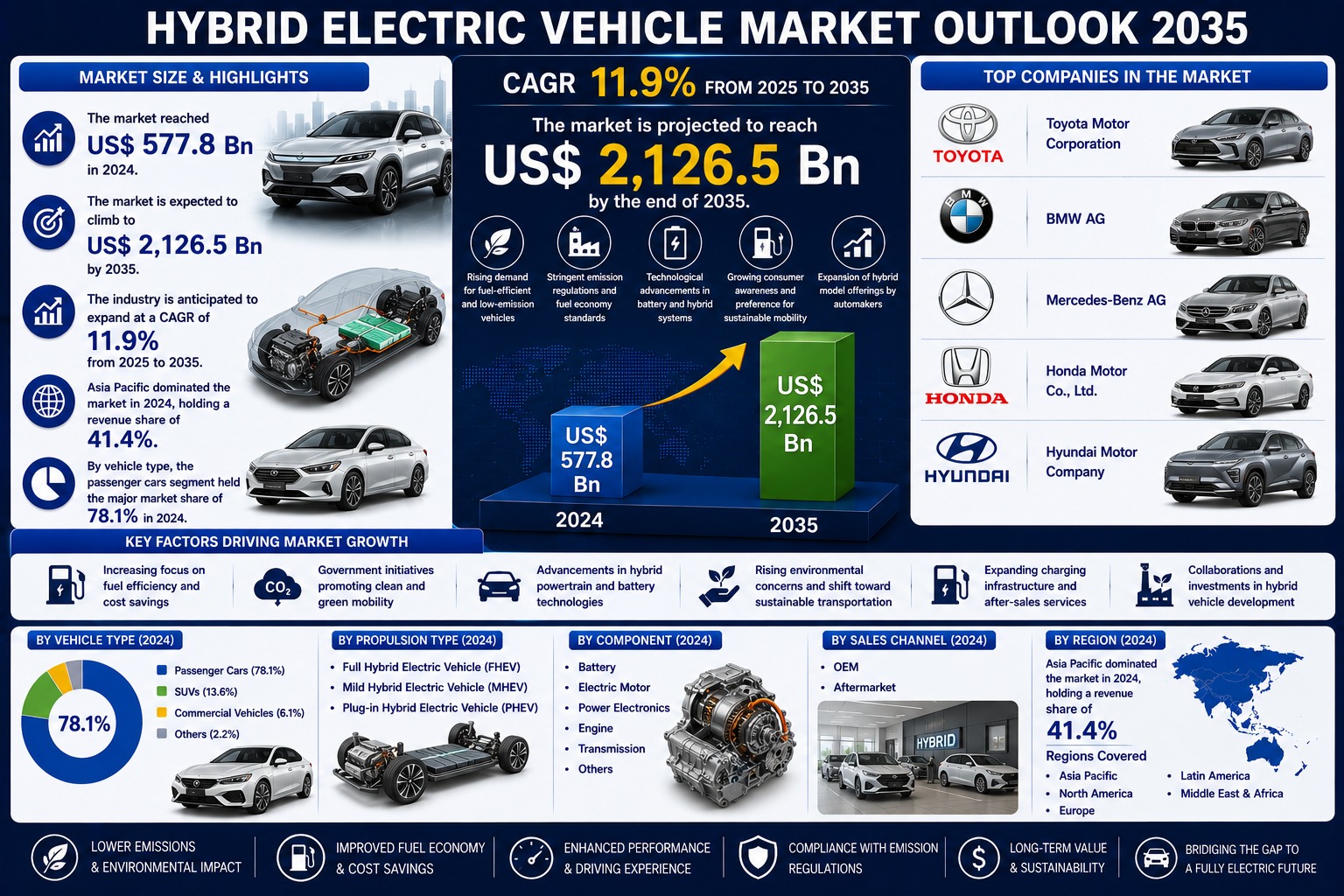
According to the latest industry analysis, the global Hybrid Electric Vehicle Market was valued at US$ 577.8 Billion in 2024 and is projected to reach US$ 2,126.5 Billion by 2035, expanding at a CAGR of 11.9% from 2025 to 2035.
Hybrid electric vehicles continue to serve as an important transition technology between conventional internal combustion engine vehicles and fully battery-electric vehicles. Unlike pure electric vehicles, hybrids offer improved fuel economy, reduced carbon emissions, and extended driving range without depending entirely on charging infrastructure.
Growing investments by leading automotive manufacturers in next-generation hybrid systems, intelligent energy management, lightweight vehicle platforms, and advanced battery technologies are expected to support sustained market growth throughout the forecast period.
→Discover Market Opportunities – Request Your Sample Copy Now: https://www.transparencymarketresearch.com/sample/sample.php?flag=S&rep_id=33647
Rising Demand for Fuel-Efficient and Low-Emission Vehicles Drives Market Growth
The increasing global demand for fuel-efficient automobiles remains one of the strongest factors driving the Hybrid Electric Vehicle Market.
Consumers are becoming more conscious of fuel expenses while governments continue promoting environmentally responsible transportation solutions. Hybrid electric vehicles combine internal combustion engines with electric motors, allowing vehicles to consume significantly less fuel while reducing greenhouse gas emissions.
Unlike conventional gasoline vehicles, hybrid systems recover braking energy, optimize engine performance, and utilize electric propulsion during low-speed driving conditions, resulting in improved fuel efficiency and lower operating costs.
The growing popularity of environmentally friendly mobility solutions has encouraged consumers to choose hybrid vehicles for daily commuting, long-distance travel, ride-sharing services, and fleet transportation.
Hybrid vehicles also eliminate concerns related to limited charging infrastructure, making them particularly attractive in regions where electric vehicle charging networks are still under development.
The combination of fuel savings, lower emissions, and operational flexibility continues to strengthen demand across developed and emerging automotive markets.
Stringent Emission Regulations Accelerate Hybrid Vehicle Adoption
Governments worldwide are implementing increasingly stringent emission standards and fuel economy regulations to reduce transportation-related carbon emissions.
Automobile manufacturers are under growing pressure to meet regulatory targets while maintaining vehicle performance and affordability.
Hybrid electric vehicles provide manufacturers with an effective pathway to reduce fleet-average emissions without relying exclusively on fully electric vehicle production.
Several countries continue introducing carbon reduction policies, fuel economy standards, and tax incentives supporting hybrid vehicle adoption.
Automotive companies are therefore expanding hybrid product portfolios across multiple vehicle categories to comply with evolving environmental regulations.
As governments continue tightening emission standards throughout North America, Europe, Asia Pacific, and other major automotive markets, hybrid technology is expected to remain a critical component of global vehicle electrification strategies.
Continuous Innovation in Hybrid Technology Enhances Market Competitiveness
Rapid technological advancements are significantly improving hybrid vehicle performance, efficiency, and consumer acceptance.
Leading manufacturers are introducing next-generation hybrid systems featuring more efficient electric motors, higher-capacity batteries, intelligent power management software, regenerative braking systems, and lightweight vehicle architectures.
Modern hybrid vehicles deliver smoother acceleration, quieter operation, improved fuel economy, and enhanced driving comfort compared to earlier generations.
Advancements in lithium-ion batteries, power electronics, and thermal management systems have further improved hybrid system reliability and overall vehicle efficiency.
Automakers are also adopting modular vehicle platforms capable of supporting multiple electrified powertrains, including mild hybrids, full hybrids, and plug-in hybrid electric vehicles.
These flexible platforms reduce production costs while allowing manufacturers to respond quickly to changing consumer preferences and regulatory requirements.
As research and development investments continue increasing, hybrid technology will remain an important pillar of future automotive innovation.
Growing Charging Infrastructure Gap Supports Hybrid Demand
Although battery-electric vehicle adoption continues to rise globally, charging infrastructure remains unevenly distributed across many regions.
Consumers in rural areas, developing economies, and regions with limited charging networks often prefer hybrid electric vehicles because they eliminate range anxiety while providing many of the environmental benefits associated with electrified transportation.
Hybrid vehicles require no external charging in the case of conventional HEVs, allowing drivers to refuel using existing gasoline infrastructure while benefiting from improved fuel economy.
Plug-in hybrid electric vehicles (PHEVs) further enhance flexibility by offering extended electric-only driving for short urban trips while retaining gasoline engines for longer journeys.
This unique combination of convenience and efficiency positions hybrid vehicles as an ideal transitional technology during the global shift toward zero-emission mobility
→Explore Strategies & Trends – Request Full Report Access – https://www.transparencymarketresearch.com/sample/sample.php?flag=S&rep_id=33647
Passenger Cars Continue Dominating the Hybrid Electric Vehicle Market
Passenger cars represent the largest segment of the global Hybrid Electric Vehicle Market, accounting for 78.1% of total market revenue in 2024.
The dominance of this segment is driven by rising consumer demand for economical, environmentally friendly personal transportation.
Hybrid passenger vehicles provide significant fuel savings during daily commuting while maintaining driving performance suitable for both urban and highway conditions.
Major automotive manufacturers continue expanding hybrid versions of popular sedan, hatchback, SUV, and crossover models to meet growing customer demand.
Improved affordability, enhanced vehicle performance, advanced safety technologies, and attractive government incentives have further accelerated passenger car adoption.
Ride-sharing companies, taxi operators, and corporate fleets are also increasingly deploying hybrid passenger vehicles to reduce operating expenses and lower carbon emissions.
As consumers continue prioritizing sustainability and fuel efficiency, passenger cars are expected to remain the leading vehicle category throughout the forecast period.
Asia Pacific Leads the Global Hybrid Electric Vehicle Market
Asia Pacific accounted for 41.4% of global Hybrid Electric Vehicle Market revenue in 2024, making it the largest regional market worldwide.
The region benefits from a strong automotive manufacturing ecosystem, supportive government policies, rising environmental awareness, and growing urbanization.
Countries including Japan, China, India, and South Korea continue driving regional growth through investments in vehicle electrification, clean transportation initiatives, and automotive research.
Japan remains a global leader in hybrid technology innovation, with several pioneering manufacturers introducing highly efficient hybrid powertrains that have achieved worldwide commercial success.
China continues expanding hybrid vehicle production alongside battery-electric vehicle manufacturing, supported by favorable industrial policies and increasing consumer demand.
India is also experiencing rising hybrid adoption as consumers seek fuel-efficient alternatives amid fluctuating fuel prices and expanding environmental regulations.
The region’s well-established automotive supply chain, battery manufacturing capabilities, and extensive vehicle production infrastructure further strengthen Asia Pacific’s leadership in the global market.
Expanding Applications Across Commercial Transportation
Beyond passenger vehicles, hybrid technology is increasingly penetrating commercial transportation sectors.
Businesses operating delivery fleets, logistics vehicles, taxis, buses, and municipal transportation systems are adopting hybrid vehicles to lower fuel expenses while meeting sustainability targets.
Fleet operators benefit from reduced maintenance requirements, improved fuel efficiency, and lower total cost of ownership compared to conventional internal combustion vehicles.
Government agencies are also incorporating hybrid vehicles into public transportation fleets to reduce emissions without requiring extensive charging infrastructure investments.
As commercial transportation increasingly prioritizes operational efficiency and environmental performance, hybrid electric vehicles are expected to capture a growing share of fleet procurement activities worldwide.
Competitive Landscape
The Hybrid Electric Vehicle Market remains highly competitive, with global automotive manufacturers investing heavily in advanced hybrid powertrains, battery technologies, software-defined vehicle platforms, and intelligent energy management systems.
Major companies operating in the market include Toyota Motor Corporation, Honda Motor Co., Ltd., Hyundai Motor Company, BMW AG, Mercedes-Benz AG, Volkswagen Group, Nissan, Ford Motor Company, General Motors, BYD Co., Ltd., Renault SAS, Volvo Car Corporation, Mitsubishi Motors Corporation, ZF Friedrichshafen AG, and YAMAHA Motor Pvt. Ltd.
These companies continue strengthening their market positions through product innovation, manufacturing expansion, strategic partnerships, localized production, and continuous investment in electrification technologies.
Recent Industry Developments
Several strategic developments continue shaping the Hybrid Electric Vehicle Market.
In November 2025, Honda showcased its next-generation hybrid technologies during the Honda Automotive Technology Workshop, introducing advanced e systems designed to improve fuel efficiency, driving performance, and overall vehicle appeal for future electrified models.
In April 2024, Ford Motor Company revised its electrification strategy by expanding hybrid vehicle production while investing in advanced battery technologies, new hybrid platforms, BlueOval City manufacturing facilities, and long-term electric vehicle development.
These developments demonstrate the automotive industry’s commitment to balancing hybrid technology expansion with broader electrification strategies.
Future Outlook
The future of the global Hybrid Electric Vehicle Market remains highly promising as governments, consumers, and automotive manufacturers continue prioritizing sustainable transportation solutions.
Growing fuel efficiency requirements, stricter emission regulations, technological innovation, expanding hybrid model availability, and increasing consumer acceptance will continue driving market growth through 2035.
Hybrid electric vehicles will remain an essential bridge between traditional internal combustion vehicles and fully electric mobility, particularly in regions where charging infrastructure continues to evolve.
With ongoing investments in battery technologies, intelligent powertrain management, lightweight materials, and advanced vehicle platforms, the Hybrid Electric Vehicle Market is well positioned for sustained long-term expansion, supporting the global transition toward cleaner, smarter, and more efficient transportation.
Buy Full Report Now: https://www.transparencymarketresearch.com/checkout.php?rep_id=33647<ype=S
→Explore Latest Research Reports by Transparency Market Research:
All-Wheel Drive (AWD) Vehicle Market
Automotive 3D Map System Market
About Transparency Market Research
Transparency Market Research, a global market research company registered at Wilmington, Delaware, United States, provides custom research and consulting services. Our exclusive blend of quantitative forecasting and trends analysis provides forward-looking insights for thousands of decision makers. Our experienced team of Analysts, Researchers, and Consultants use proprietary data sources and various tools & techniques to gather and analyses information.
Our data repository is continuously updated and revised by a team of research experts, so that it always reflects the latest trends and information. With a broad research and analysis capability, Transparency Market Research employs rigorous primary and secondary research techniques in developing distinctive data sets and research material for business reports.
Media Contact:
Abhishek Budholiya
Transparency Market Research Inc.
State Tower, 90 State Street, Suite 700,
Albany NY – 12207, United States
Tel: +1-518-618-1030
USA – Canada Toll Free: 866-552-3453
Website: https://www.transparencymarketresearch.com
Sales Inquiries: sales@transparencymarketresearch.com
Media Inquiries: media@transparencymarketresearch.com