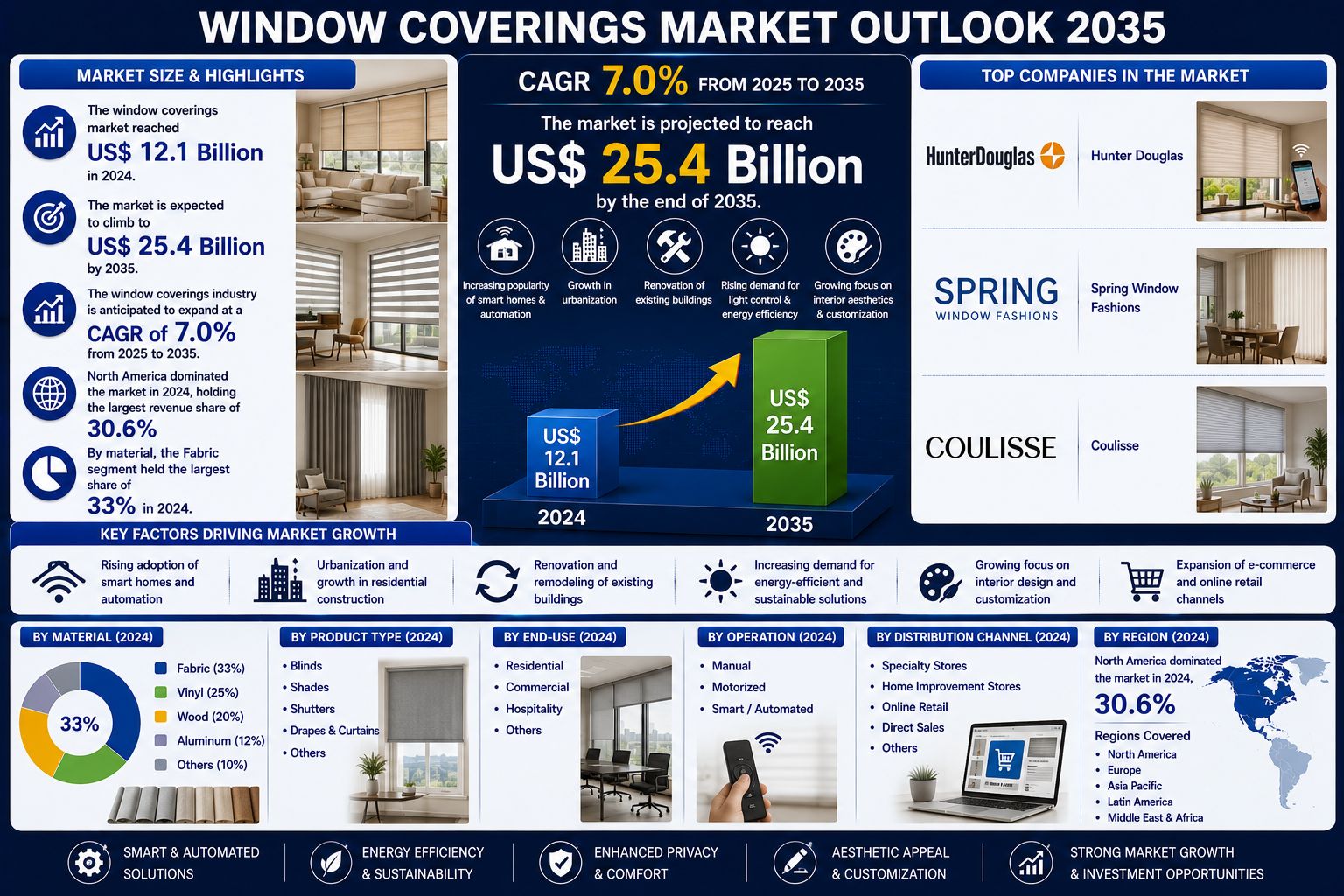
The global window coverings market is witnessing remarkable growth as consumers increasingly prioritize smart home technologies, energy efficiency, and modern interior aesthetics. According to industry estimates, the global window coverings market was valued at US$ 12.1 billion in 2024 and is projected to reach US$ 25.4 billion by 2035, expanding at a CAGR of 7.0% during the forecast period from 2025 to 2035. The rising popularity of automated blinds, smart shades, eco-friendly materials, and large-scale residential renovation projects continues to create strong opportunities for manufacturers worldwide.
Window coverings have evolved from simple decorative accessories into intelligent building solutions that improve energy efficiency, enhance occupant comfort, and integrate seamlessly with connected home ecosystems. From residential apartments to commercial office buildings, modern window treatments are becoming an essential element of sustainable building design
→Discover Market Opportunities – Request Your Sample Copy Now: https://www.transparencymarketresearch.com/sample/sample.php?flag=S&rep_id=86906
Window Coverings Market Overview
Window coverings include a wide range of products such as blinds, shades, curtains, drapes, shutters, and window films designed to regulate sunlight, improve privacy, enhance thermal insulation, and elevate interior aesthetics. These products are manufactured using materials such as fabric, wood, plastic, metal, and composite materials to suit different residential and commercial applications.
The industry has experienced significant transformation over the last decade due to technological advancements in motorization and smart automation. Consumers now demand window coverings that can be controlled using smartphones, voice assistants, sensors, and programmable schedules. These innovations not only improve convenience but also contribute significantly to energy conservation by optimizing natural lighting and indoor temperature.
As governments promote energy-efficient buildings and consumers increasingly invest in home improvement projects, manufacturers continue introducing innovative products that combine functionality, style, and sustainability.
Smart Home Adoption Accelerates Market Growth
One of the strongest growth drivers for the global window coverings market is the rapid expansion of smart home ecosystems. Homeowners are increasingly investing in connected devices that improve convenience, security, and energy management. Motorized blinds and smart shades have become an integral component of these intelligent living environments.
Modern window coverings now integrate with platforms including Amazon Alexa, Google Home, and Apple HomeKit, allowing users to control lighting and privacy through voice commands or mobile applications. Smart scheduling enables blinds to open automatically during daylight hours and close during peak sunlight to reduce indoor temperatures.
According to the International Energy Agency (IEA), more than 320 million smart homes existed globally in 2024, with adoption expected to continue growing at an annual rate exceeding 20% through 2030. This expanding installed base creates enormous opportunities for manufacturers developing IoT-enabled window treatment solutions.
Commercial buildings are also embracing automated shading systems integrated with daylight sensors and building management software to reduce HVAC consumption and improve occupant comfort.
Urbanization and Building Renovation Drive Demand
Rapid urbanization continues to stimulate demand for window coverings across residential and commercial sectors. Expanding cities in developing economies are generating substantial construction activity, resulting in increased installations of modern window treatment solutions.
The United Nations estimates that over 56% of the world’s population lived in urban areas during 2024, with this figure expected to reach 68% by 2050. Growing urban populations require new housing developments, office complexes, hotels, hospitals, educational institutions, and retail spaces where window coverings serve both functional and decorative purposes.
Simultaneously, mature markets across North America and Europe are witnessing rising renovation activities. Aging buildings require upgraded insulation, improved daylight management, and enhanced energy performance. Modern blinds, shades, and insulated curtains help reduce heating and cooling costs while providing greater comfort.
The increasing popularity of interior design, home remodeling, and premium home décor further supports demand for customized and aesthetically appealing window treatment products.
Energy Efficiency Becomes a Major Purchasing Factor
Energy conservation has become one of the most influential purchasing considerations in the window coverings industry. Governments, commercial property owners, and homeowners increasingly recognize the role window treatments play in reducing energy consumption.
Studies conducted by the U.S. Department of Energy indicate that advanced cellular shades can reduce solar heat gain by as much as 80%, significantly lowering air-conditioning requirements during hot weather. Proper insulation also minimizes heat loss during winter, improving overall building energy performance.
Office buildings increasingly deploy automated blinds connected to daylight sensors that optimize natural lighting throughout the day. Such systems reduce artificial lighting requirements while maintaining employee comfort and productivity.
Manufacturers continue investing in energy-efficient fabrics, reflective coatings, solar-powered motors, and intelligent automation technologies that support sustainable construction initiatives worldwide.
Blinds and Shades Lead Product Segment
Among all product categories, blinds and shades remain the dominant segment within the global window coverings market. Their versatility, affordability, modern appearance, and superior light control capabilities make them the preferred choice across residential and commercial applications.
Roller blinds, Venetian blinds, Roman shades, and cellular shades offer flexible privacy control while improving insulation and reducing glare. Their compatibility with motorized systems has further strengthened market demand.
Cordless blackout shades have become increasingly popular in residential bedrooms, children’s rooms, hotels, and healthcare facilities due to enhanced safety, improved sleep quality, and modern aesthetics.
Continuous innovation in sustainable materials, automated controls, and IoT-enabled shading solutions ensures that blinds and shades will maintain their leadership position throughout the forecast period.
Fabric Emerges as the Leading Material
By material, the fabric segment accounted for approximately 33% of the global market in 2024. Fabric remains highly preferred due to its versatility, wide design options, affordability, and excellent insulation characteristics.
Manufacturers now offer premium fabrics featuring UV resistance, antimicrobial coatings, fire-retardant properties, blackout capabilities, and recyclable compositions. Growing demand for eco-friendly home furnishings has encouraged the adoption of organic cotton, recycled polyester, bamboo fibers, and other sustainable textile materials.
Consumers increasingly seek customized colors, textures, and patterns that complement modern interior designs while supporting energy efficiency objectives.
→Explore Strategies & Trends – Request Full Report Access – https://www.transparencymarketresearch.com/sample/sample.php?flag=S&rep_id=86906
North America Maintains Market Leadership
North America accounted for 30.6% of global market revenue in 2024, making it the largest regional market for window coverings.
The region benefits from strong consumer spending on home improvement, widespread adoption of smart home technologies, and increasing emphasis on energy-efficient residential construction. The United States remains the primary contributor, supported by growing installations of automated blinds, motorized shades, and connected home devices.
Industry reports suggest that more than 45% of newly constructed homes in the United States incorporated smart or motorized window coverings during 2024, highlighting strong consumer acceptance of intelligent home solutions.
Europe continues to represent a significant market owing to stringent energy efficiency regulations, green building initiatives, and growing demand for sustainable construction materials.
Meanwhile, Asia Pacific is emerging as the fastest-growing regional market due to rapid urbanization, expanding middle-class populations, rising disposable incomes, and extensive residential development across China, India, Indonesia, and Southeast Asia.
Competitive Landscape Focuses on Innovation
The global window coverings market remains highly competitive with leading manufacturers investing heavily in automation technologies, sustainable materials, and premium product designs.
Hunter Douglas continues to dominate the global industry through its extensive portfolio of blinds, shades, shutters, and motorized solutions marketed under brands such as Levolor, Luxaflex, and 3 Day Blinds. The company operates across more than 100 countries while continuously expanding its smart home capabilities.
Springs Window Fashions remains one of the industry’s largest competitors, offering products under the Bali, Graber, and SunSetter brands. The company focuses on digital customer experiences, environmentally responsible materials, and innovative motorization technologies.
Other major participants include Somfy Systems Inc., NNK Window Covering, Lafayette Interior Fashions, Comfortex Window Fashions, Coulisse, Louvolite, Kvadrat Shade B.V., and MechoShade Systems Inc., each contributing through product innovation and geographic expansion.
Recent developments demonstrate the industry’s strong innovation momentum. Hunter Douglas upgraded its PowerView smart-shading platform during 2025 with improved motor performance and expanded smart-home compatibility. Coulisse introduced advanced Motionblinds concepts featuring AI-assisted design tools and ultra-quiet motor systems, while SelectBlinds gained industry recognition for its automated window treatment solutions with superior smart-home integration.
Future Outlook
The future of the global window coverings market appears highly promising as technological innovation, sustainability initiatives, and smart building adoption continue accelerating worldwide. Consumers increasingly seek products that combine aesthetics with intelligent automation, energy efficiency, and environmental responsibility.
Growing investments in urban housing, commercial infrastructure, and renovation activities will sustain long-term demand across both developed and emerging economies. As smart homes become mainstream rather than premium offerings, motorized blinds, connected shades, and automated window management systems are expected to become standard features in modern buildings.
With continuous advancements in IoT integration, eco-friendly materials, AI-enabled automation, and customized interior solutions, the global window coverings market is well positioned to nearly double in value by 2035, creating substantial growth opportunities for manufacturers, technology providers, and building solution companies worldwide.
Buy Full Report Now: https://www.transparencymarketresearch.com/checkout.php?rep_id=86906<ype=S
→Explore Latest Research Reports by Transparency Market Research:
Injection Molded Plastics Market
About Transparency Market Research
Transparency Market Research, a global market research company registered at Wilmington, Delaware, United States, provides custom research and consulting services. Our exclusive blend of quantitative forecasting and trends analysis provides forward-looking insights for thousands of decision makers. Our experienced team of Analysts, Researchers, and Consultants use proprietary data sources and various tools & techniques to gather and analyses information.
Our data repository is continuously updated and revised by a team of research experts, so that it always reflects the latest trends and information. With a broad research and analysis capability, Transparency Market Research employs rigorous primary and secondary research techniques in developing distinctive data sets and research material for business reports.
Media Contact:
Abhishek Budholiya
Transparency Market Research Inc.
State Tower, 90 State Street, Suite 700,
Albany NY – 12207, United States
Tel: +1-518-618-1030
USA – Canada Toll Free: 866-552-3453
Website: https://www.transparencymarketresearch.com
Sales Inquiries: sales@transparencymarketresearch.com
Media Inquiries: media@transparencymarketresearch.com