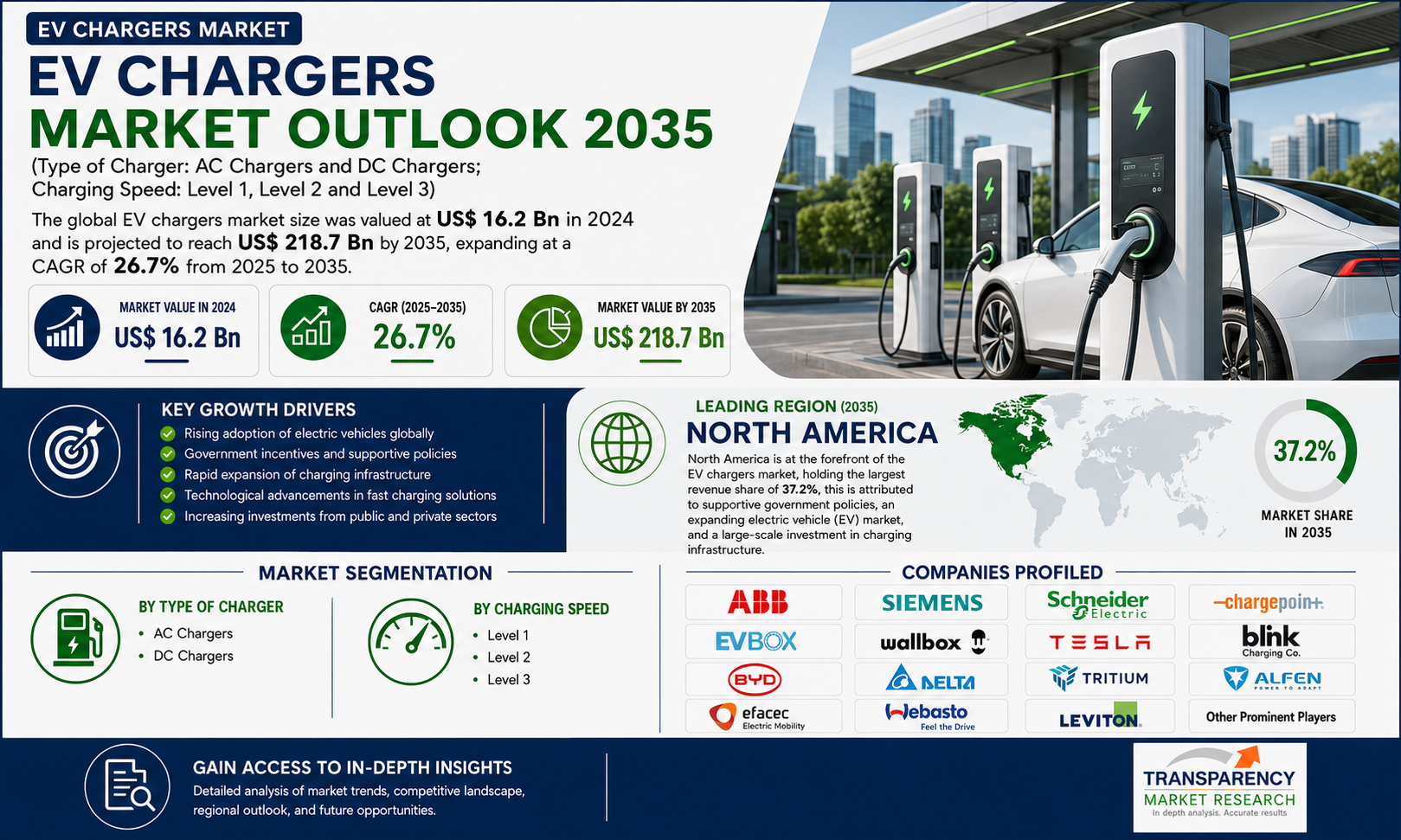
The global EV chargers market is experiencing remarkable growth as the automotive industry undergoes a transformative shift toward sustainable mobility. According to the latest market analysis, the global EV chargers market was valued at US$ 16.2 Billion in 2024 and is projected to reach US$ 218.7 Billion by 2035, expanding at a robust CAGR of 26.7% during the forecast period from 2025 to 2035.
The rapid adoption of electric vehicles (EVs), favorable government policies, increasing environmental awareness, and expanding renewable energy infrastructure are collectively driving demand for advanced EV charging solutions worldwide. As consumers and businesses transition toward cleaner transportation alternatives, investments in charging infrastructure are accelerating across residential, commercial, and public sectors.
Explore our report to gain an in-depth view of the key findings –
https://www.transparencymarketresearch.com/sample/sample.php?flag=S&rep_id=85291
Market Size
The EV chargers market has emerged as one of the fastest-growing segments within the global clean energy and transportation ecosystem.
Key Market Statistics
- Market Size (2024): US$ 16.2 Billion
- Forecast Value (2035): US$ 218.7 Billion
- CAGR (2025–2035): 26.7%
- Leading Region (2024): North America with 37.2% market share
- Dominant Charging Speed Segment: Level 2 Chargers with 66.2% market share in 2024
The impressive growth trajectory reflects increasing investments in charging infrastructure, growing EV ownership, and technological advancements in charging systems worldwide.
Market Overview
Electric vehicle chargers serve as the backbone of the EV ecosystem, enabling efficient charging across homes, workplaces, commercial facilities, and public charging stations. The market encompasses a broad range of charging technologies, including Level 1, Level 2, and DC fast chargers, each designed to cater to specific charging requirements and user preferences.
Level 1 chargers typically utilize standard household outlets and are commonly deployed in residential settings. Level 2 chargers provide faster charging capabilities and are widely used across residential and public charging networks. DC fast chargers represent the highest-speed charging solutions, enabling drivers to recharge substantial battery capacity within a short period, making long-distance travel increasingly practical.
The market is also witnessing innovation through smart charging systems, renewable energy integration, wireless charging technologies, and solar-powered charging infrastructure. These advancements are strengthening the overall charging ecosystem while supporting global sustainability objectives.
Governments across developed and emerging economies continue to promote EV adoption through incentives, subsidies, tax rebates, and emissions regulations, creating favorable conditions for market expansion.
Key Market Growth Drivers
Rising Adoption of Electric Vehicles
One of the primary drivers fueling market expansion is the accelerating adoption of electric vehicles globally. Consumers are increasingly choosing EVs as environmentally responsible alternatives to traditional internal combustion engine vehicles.
Advancements in battery technology, extended driving ranges, declining battery costs, and enhanced vehicle performance are making EVs more attractive to mainstream consumers. Simultaneously, leading automotive manufacturers are committing significant resources toward vehicle electrification, introducing a growing portfolio of electric models across various vehicle categories.
Government support through tax incentives, subsidies, and emissions regulations continues to encourage EV purchases, thereby increasing demand for reliable charging infrastructure.
Growth of Renewable Energy Sources
The rapid expansion of renewable energy generation is creating favorable conditions for EV charger deployment. Solar, wind, and hydroelectric energy sources are increasingly being integrated into charging networks, enhancing sustainability and reducing reliance on conventional power generation.
Solar-powered charging stations, in particular, are gaining momentum as they offer clean and independent energy solutions while minimizing operational costs. The combination of renewable energy and EV charging infrastructure supports long-term decarbonization goals and strengthens energy security.
Growing Environmental Awareness
Environmental concerns and climate change mitigation efforts are encouraging consumers, businesses, and governments to adopt sustainable transportation solutions. Electric vehicles play a crucial role in reducing greenhouse gas emissions, and the availability of accessible charging infrastructure remains critical to supporting widespread adoption.
As sustainability initiatives become increasingly important across industries, demand for EV chargers is expected to continue growing substantially.
Buy this Premium Research Report and unlock critical data and findings –
https://www.transparencymarketresearch.com/checkout.php?rep_id=85291<ype=S
Infrastructure Investments
Public and private sector investments in charging infrastructure are expanding rapidly. Governments are allocating significant funding toward nationwide charging networks, while private operators are developing innovative charging solutions to meet growing demand.
These investments are helping reduce range anxiety and improve convenience for EV users, ultimately accelerating market growth.
Analysis of Key Players – Key Player Strategies
The global EV chargers market is highly competitive and characterized by continuous innovation, strategic partnerships, geographic expansion, and product development initiatives.
Major market participants include:
- ABB Ltd
- Siemens AG
- Schneider Electric
- ChargePoint Holdings, Inc.
- EVBox Group
- Wallbox N.V.
- Tesla, Inc.
- Blink Charging Co.
- BYD Company Ltd.
- Delta Electronics, Inc.
- Tritium DCFC Ltd.
- Alfen N.V.
- Efacec Electric Mobility
- Webasto Group
- Leviton Manufacturing Co.
These companies are actively investing in research and development to introduce faster, smarter, and more energy-efficient charging technologies.
ABB Ltd continues to strengthen its market position through advanced DC fast-charging solutions and global infrastructure projects. Siemens AG focuses on digitalized charging ecosystems and smart energy management capabilities. Schneider Electric emphasizes integrated energy solutions that combine EV charging with renewable energy and grid optimization.
ChargePoint Holdings, Inc. remains focused on expanding its charging network footprint while enhancing software-driven charging management platforms. Tesla continues to leverage its extensive Supercharger network as a key competitive advantage, supporting both existing and future EV users.
Meanwhile, emerging players and regional manufacturers are increasingly entering the market through localized production, technology partnerships, and infrastructure deployment initiatives.
Market Challenges & Opportunities
Challenges
High Infrastructure Costs
Establishing comprehensive charging networks requires substantial capital investments. Installation costs, grid upgrades, maintenance requirements, and land acquisition expenses can present challenges for infrastructure developers.
Range Anxiety
Although charging infrastructure is expanding rapidly, many consumers remain concerned about charging availability and vehicle range, particularly in rural and remote regions.
Standardization Issues
The presence of multiple connector standards and charging protocols can create compatibility challenges across markets and vehicle manufacturers.
Grid Capacity Constraints
The increasing number of EVs and charging stations may place additional pressure on existing electrical grids, requiring infrastructure upgrades and smarter energy management systems.
Opportunities
Ultra-Fast Charging Technologies
Growing demand for reduced charging times is creating opportunities for next-generation DC fast chargers and ultra-fast charging solutions.
Smart Charging Solutions
The integration of artificial intelligence, IoT technologies, and cloud-based management systems enables smart charging capabilities, creating new revenue streams and operational efficiencies.
Renewable Energy Integration
Combining EV charging with renewable energy generation and energy storage systems presents significant growth opportunities for market participants.
Emerging Markets Expansion
Rapid urbanization and increasing EV adoption in Asia Pacific, Latin America, and Middle Eastern countries are expected to create substantial market opportunities throughout the forecast period.
Key Player Strategies
Leading companies are implementing several strategic initiatives to maintain competitive advantages and capture market share.
Technology Innovation
Companies are investing heavily in advanced charging technologies, including ultra-fast charging systems, wireless charging solutions, and smart charging platforms.
Strategic Partnerships
Collaborations between charging providers, automotive manufacturers, utility companies, and governments are accelerating infrastructure deployment and market penetration.
Geographic Expansion
Market leaders continue expanding their presence across emerging economies where EV adoption is gaining momentum.
Manufacturing Capacity Expansion
Increasing production capabilities helps companies address growing demand while improving supply chain efficiency and cost competitiveness.
Renewable Energy Integration
Many market participants are incorporating renewable energy and energy storage technologies into their charging solutions to support sustainability objectives.
Recent Developments
- In September 2025, Tata Power, along with Tata Passenger Electric Mobility, introduced the TATA.ev “MegaCharger” concept and inaugurated a large charging hub in Mumbai in September 2025.
- In May 2025, Amplify Mobility Pvt Ltd inaugurated a new manufacturing facility in Hyderabad, dedicated to producing EV chargers. This expansion aims to meet the growing demand for EV charging infrastructure and supports both international and domestic markets.
- In March 2025, Jigowatts (Japanese EV charger hardware+software solutions) forged a strategic partnership with VVDN. The objective is to manufacture and scale EV chargers in India and export to ASEAN, Middle East, and Europe.
Investment Landscape and ROI Outlook
The EV chargers market presents substantial investment opportunities due to strong long-term growth fundamentals. Governments worldwide continue allocating funding toward transportation electrification, while private investors increasingly recognize charging infrastructure as a critical component of future mobility ecosystems.
Investments are flowing into:
- Public charging networks
- Fast-charging corridors
- Residential charging solutions
- Smart charging software platforms
- Renewable-powered charging stations
- Energy storage integration projects
The projected CAGR of 26.7% indicates strong revenue generation potential for infrastructure developers, technology providers, equipment manufacturers, and network operators.
As EV penetration rates continue increasing globally, utilization rates for charging infrastructure are expected to improve significantly, enhancing return on investment and supporting sustainable long-term profitability.
Market Segmentations
By Type of Charger
AC Chargers
- Mode 1 (2.3 kW)
- Mode 2 (2.3 kW)
- Mode 3 (3.7 kW to 22 kW)
DC Chargers
By Charging Speed
- Level 1
- Level 2
- Level 3
By Connector Type
- Type 1
- Type 2
- CCS
- CHAdeMO
- Others
By Installation
- Fixed
- Portable
By End-user
- Commercial
- Residential
By Region
North America
- U.S.
- Canada
Europe
- Germany
- U.K.
- France
- Italy
- Spain
- The Netherlands
Asia Pacific
- China
- India
- Japan
- South Korea
- Australia
- ASEAN
Latin America
- Brazil
- Mexico
- Argentina
Middle East & Africa
- GCC Countries
- South Africa
Why Buy This Report?
- Gain comprehensive insights into the global EV chargers market from 2025 to 2035.
- Understand key growth drivers, challenges, and emerging opportunities.
- Analyze competitive positioning and strategies of leading market participants.
- Evaluate regional market trends and investment prospects.
- Access detailed segmentation analysis across charger types, charging speeds, connectors, installations, and end-user categories.
- Identify future revenue opportunities and high-growth markets.
- Support strategic planning, expansion initiatives, and investment decisions with reliable market intelligence.
Frequently Asked Questions (FAQs)
1. What is the projected size of the EV chargers market by 2035?
The global EV chargers market is projected to reach US$ 218.7 Billion by 2035.
2. What is the expected CAGR of the market during 2025–2035?
The market is anticipated to expand at a CAGR of 26.7% during the forecast period.
3. Which region dominated the EV chargers market in 2024?
North America held the largest market share in 2024, accounting for 37.2% of global revenue.
4. Which charging speed segment led the market in 2024?
The Level 2 charging segment dominated the market, holding 66.2% of the total market share.
5. What are the major factors driving market growth?
Key growth drivers include rising electric vehicle adoption, expansion of renewable energy sources, increasing environmental awareness, government incentives, and growing investments in charging infrastructure.
About Transparency Market Research
Transparency Market Research, a global market research company registered at Wilmington, Delaware, United States, provides custom research and consulting services. Our exclusive blend of quantitative forecasting and trends analysis provides forward-looking insights for thousands of decision makers. Our experienced team of Analysts, Researchers, and Consultants use proprietary data sources and various tools & techniques to gather and analyses information.
Our data repository is continuously updated and revised by a team of research experts, so that it always reflects the latest trends and information. With a broad research and analysis capability, Transparency Market Research employs rigorous primary and secondary research techniques in developing distinctive data sets and research material for business reports.
Media Contact:
Abhishek Budholiya
Transparency Market Research Inc.
State Tower, 90 State Street, Suite 700,
Albany NY – 12207, United States
Tel: +1-518-618-1030
USA – Canada Toll Free: 866-552-3453
Website: https://www.transparencymarketresearch.com
Sales Inquiries: sales@transparencymarketresearch.com
Media Inquiries: media@transparencymarketresearch.com