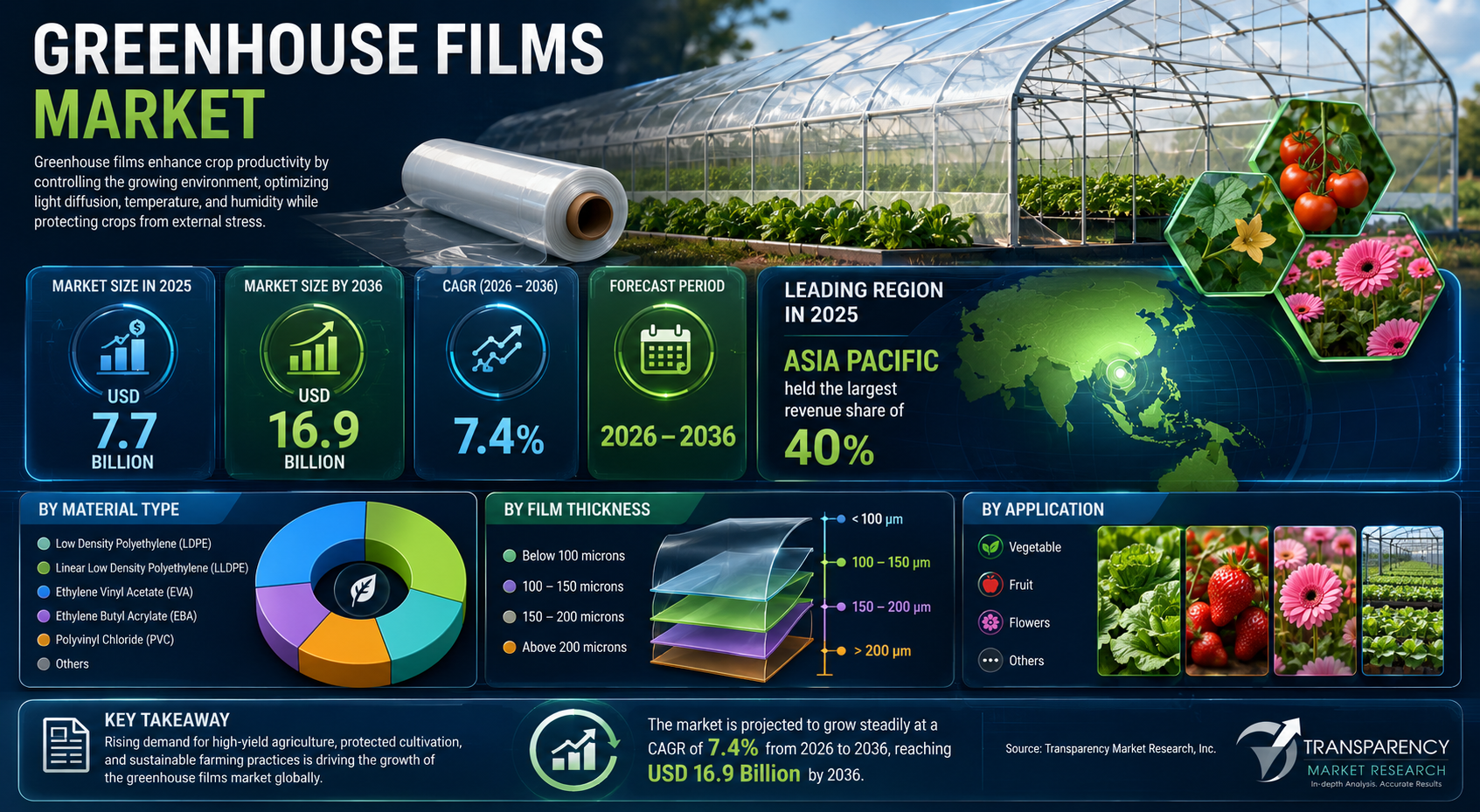
The global greenhouse films market was valued at USD 7.7 Billion in 2025 and is projected to reach USD 16.9 Billion by 2036. The industry is expected to grow at a CAGR of 7.4% from 2026 to 2036, driven by increasing adoption of protected agriculture, rising demand for high-yield crop production, and advancements in durable film technologies.
Dive Deeper into Data: Get Your In-Depth Sample Now! https://www.transparencymarketresearch.com/sample/sample.php?flag=S&rep_id=17306
Market Overview
Greenhouse films imply specialized, polymer-based plastic sheets utilized as cladding materials for greenhouses, polytunnels, and high tunnels. These technical films are engineered predominantly from low-density polyethylene (LDPE), linear low-density polyethylene (LLDPE), and ethylene-vinyl acetate (EVA) copolymers. The final products are designed to be high-strength, flexible, structurally lightweight, and optimized for maximum light transmission while shielding crops from severe external weather.
Greenhouse films are utilized across the global agricultural sector, primarily for the cultivation of high-value vegetables, fruits, flowers, and ornamental nursery crops. Thicker, multi-season multi-layer films are heavily favored in commercial, large-scale horticulture farms across North America and Europe to stabilize microclimates. Meanwhile, single-layer configurations provide cost-effective crop protection in price-sensitive, highly distributed agricultural hubs across emerging economies.
A primary factor influencing demand is the pressing need for water conservation and climate resilience in hyper-arid or unpredictable weather zones. The shift toward high-performance functional films is further driven by strict regional agricultural directives optimizing pesticide reduction and encouraging food security. Company commitments to improving crop export quality, combined with growing consumer preference for fresh, locally-sourced produce, drive the market further.
Analysts’ Viewpoint
The greenhouse films market is gaining intense momentum from structural shifts in global food supply chains and precision farming initiatives. The massive footprint expansion of protected cultivation acreage in regions like the Asia-Pacific and the Middle East is driving a highly predictable replacement and upgrading loop for optical agricultural plastics. These are fundamentally long-term structural drivers closely linked to rapid global urbanization, declining arable land per capita, and a systemic push toward lowering agricultural risk profiles.
Technological advancements are rapidly elevating agricultural films beyond basic structural weather barriers. Progress in multi-layer co-extrusion machinery, water-based anti-drip additives, and photo-selective or spectral-shifting nanoparticle masterbatches allows modern films to dynamically filter solar wavelengths. These advanced plastic skins are increasingly modified for automation compatibility; modern formulations are engineered with uniform mechanical tensile strength to endure the high structural strains applied by automated roof-rolling and ventilation systems in smart commercial polyhouses.
Analysis of Key Players
The global competitive engineering landscape is seeing intensive capital investment in advanced multi-layer (3-layer, 5-layer, and 7-layer) blown film extrusion lines and integrated polymer compounding plants.
Leading companies operating in the global greenhouse films market include:
- Agriplast Protected Cultivation Pvt Ltd.
- Armando Alvarez Group
- Avient Corporation
- Berry Global Inc.
- Essen Multipack
- Ginegar Plastic Products Ltd.
- Plastika Kritis S.A.
- Polifilm America
- RKW Group
- Sotrafa S.A.
- Tosaf Compounds Ltd.
- Tuflex
Strategic supply agreements and customized material co-developments are a prominent theme across the sector. Major plastic film converters partner directly with masterbatch suppliers and international agronomists to develop tailored, climate-specific film variants optimized for regional solar irradiation indexes.
Customize this report according to your needs@ https://www.transparencymarketresearch.com/sample/sample.php?flag=CR&rep_id=17306
Recent Developments (2025–2026)
- Early 2026: Leading agricultural plastic manufacturers introduced high-durability, multi-layer greenhouse films embedded with advanced UV-blocking nanoparticle matrices, successfully extending the functional lifespan of covers used in intense solar environments.
- Late 2025: Film converters accelerated the deployment of advanced smart-tinting and light-diffusing co-extruded polymers across European markets, satisfying strict EU green farming mandates aimed at optimizing natural energy consumption inside winter greenhouses.
- Mid 2025: Large-scale commercial agricultural operators in North America executed major multi-season film supply contracts to support massive newly constructed greenhouse complexes optimized for automated vegetable and medicinal crop processing.
Key Developments & Trends
- Multi-Layer Co-Extrusion Primacy: Widespread market transition toward 5-layer and 7-layer co-extruded films, allowing distinct mechanical, thermal, and optical properties to be embedded into individual resin zones.
- Light Diffusion Engineering: Rapid adoption of photo-selective, diffuse-light films that scatter direct sunlight evenly across the greenhouse, preventing leaf-burn and illuminating lower foliage layers.
- Anti-Drip & Anti-Fog Surfactants: Integrating long-lasting surface additives that alter the surface tension of water, forcing condensation to sheet off smoothly to eliminate fungal crop drop infections.
- Infrared & Thermal Retention: Pervasive use of IR-reflective barrier films that trap long-wave infrared radiation inside the greenhouse overnight, slashing commercial heating bills by up to 20%.
- Biodegradable & Recyclable Polymers: Escalating R&D focus on circular polyolefin loops and chemical recycling paths to offset tightening global regulations surrounding single-use post-harvest plastic waste.
Challenges
- UV Degradation Vulnerability: Constant exposure to high solar radiation continuously degrades polymer chains, leading to embrittlement, clouding, and premature structural failure if not heavily stabilized.
- Resin and Feedstock Volatility: Sharp pricing fluctuations for bulk ethylene, LDPE, and EVA polymers directly strain final manufacturing margins for processing plants.
- Severe Post-Consumer Waste: Collecting, cleaning, and recycling heavily soiled, pesticide-exposed field plastic presents massive logistics and environmental management roadblocks.
- Pesticide Chemical Resistance: High accumulations of sulfur and chlorine from crop dusting frequently attack traditional amine-based UV stabilizers, accelerating film breakdown.
Opportunities
- Arid-Zone Controlled Cultivation: Enormous volume potential for high-diffusion, heat-reflective cladding films across water-stressed regions in the Middle East and North Africa.
- Urban & Vertical Rooftop Agriculture: Supplying lightweight, high-tensile structural films tailored for commercial metropolitan rooftop farming structures.
- High-Value Medicinal & Floriculture Crops: Engineering highly specific spectral-shifting films that manipulate light wavelengths to maximize cannabinoid or active oil yields.
- Hyper-Durable Multi-Season Formats: Developing ultra-thick, cross-laminated polymers designed to withstand chronic hail, high wind forces, and intense snow loads without tearing.
Market Segmentation
By Material Type
- Low-Density Polyethylene (LDPE) (Market Leader ~43% share): Remains the cornerstone resin globally due to its excellent clarity, balance of toughness, and low cost-per-hectare ratio.
- Linear Low-Density Polyethylene (LLDPE): Heavily utilized as a blending component to significantly enhance film puncture resistance and elongation performance.
- Ethylene-Vinyl Acetate (EVA) (Fastest Growing Segment): Gaining rapid market share due to its exceptional elasticity, superior thermal insulating capacity, and high light transmission properties in cold climates.
By Thickness
- 150 to 200 Microns (Leading Segment ~47% share): The standard performance standard for multi-season commercial greenhouses, providing an optimal mix of multi-year lifespan and high light transmission.
- Below 150 Microns: Extensively used in temporary tunnels or regions with short growing seasons and low wind stresses.
- Above 200 Microns: Growing steadily in regions prone to extreme weather, requiring heavy-duty, long-lifecycle structural sheeting.
By Application
- Vegetables (Leading Segment ~55% share): Driven heavily by the high global consumer demand for fresh, pest-free salads, tomatoes, and cucumbers year-round.
- Fruits & Berries: High-growth segment leveraging covered cultivation to boost yield consistency and shelter high-value soft fruits from rain damage.
- Floriculture & Ornamentals: Steady, high-margin application segment prioritizing precision UV regulation to maximize floral color intensities and stem lengths.
Elevate Your Business Strategy! Purchase the Report for Market-Driven Insights: https://www.transparencymarketresearch.com/checkout.php?rep_id=17306<ype=S
About Transparency Market Research
Transparency Market Research, a global market research company registered at Wilmington, Delaware, United States, provides custom research and consulting services. Our exclusive blend of quantitative forecasting and trends analysis provides forward-looking insights for thousands of decision makers. Our experienced team of Analysts, Researchers, and Consultants use proprietary data sources and various tools & techniques to gather and analyses information.
Our data repository is continuously updated and revised by a team of research experts, so that it always reflects the latest trends and information. With a broad research and analysis capability, Transparency Market Research employs rigorous primary and secondary research techniques in developing distinctive data sets and research material for business reports.
Contact:
Abhishek Budholiya
Transparency Market Research Inc.
State Tower, 90 State Street, Suite 700,
Albany NY – 12207, United States
Tel: +1-518-618-1030
USA – Canada Toll Free: 866-552-3453
Website: https://www.transparencymarketresearch.com
Sales Inquiries: sales@transparencymarketresearch.com
Media Inquiries: media@transparencymarketresearch.com