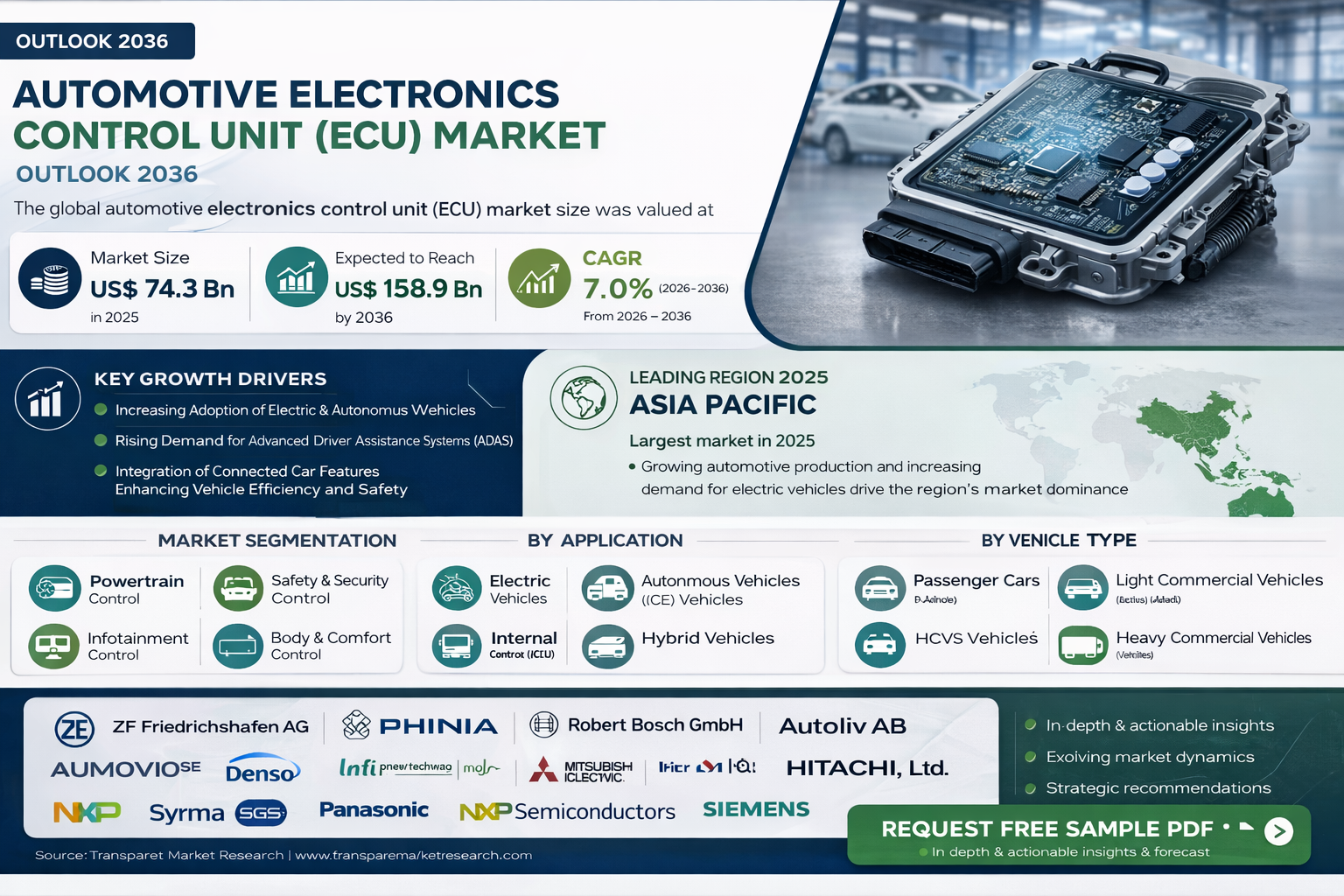
Automotive Electronics Control Unit (ECU) Market is witnessing significant growth as automakers increasingly adopt advanced electronic systems to support electrification, vehicle automation, connectivity, and enhanced safety features. According to the latest market analysis, the global Automotive Electronics Control Unit (ECU) Market was valued at US$ 74.3 Billion in 2025 and is projected to reach US$ 158.9 Billion by 2036, expanding at a CAGR of 7.0% during the forecast period from 2026 to 2036.
The market expansion is primarily fueled by the rapid penetration of electric and hybrid vehicles, growing implementation of advanced driver assistance systems (ADAS), rising demand for connected vehicles, and the transition toward software-defined vehicle architectures. Automotive manufacturers are increasingly integrating sophisticated ECU systems to improve vehicle performance, energy efficiency, safety, and user experience.
Explore the highlights and essential data from our Report in this sample –
https://www.transparencymarketresearch.com/sample/sample.php?flag=S&rep_id=86926
Market Size
The global Automotive Electronics Control Unit (ECU) Market has emerged as one of the most important segments within the automotive electronics industry. The market achieved a valuation of US$ 74.3 Billion in 2025 and is expected to nearly double over the next decade, reaching US$ 158.9 Billion by 2036.
The market’s robust trajectory reflects the increasing dependence of modern vehicles on electronic control systems. Contemporary vehicles contain multiple ECUs responsible for managing essential functions such as engine control, transmission management, safety systems, battery monitoring, body electronics, climate control, infotainment, and autonomous driving technologies.
The continued evolution of electric vehicles (EVs), hybrid electric vehicles (HEVs), connected vehicles, and autonomous driving platforms is expected to significantly accelerate ECU deployment globally.
Market Highlights
- Market Size (2025): US$ 74.3 Billion
- Forecast Value (2036): US$ 158.9 Billion
- CAGR (2026–2036): 7.0%
- Leading Region: Asia Pacific
- Regional Market Share (2025): 48%
- Largest Vehicle Segment: Passenger Cars
- Passenger Car Market Share (2025): 72%
Market Overview
Automotive Electronic Control Units (ECUs) are embedded systems that manage and control various electronic subsystems within vehicles. These units process real-time data received from sensors and execute commands that optimize vehicle performance, safety, comfort, efficiency, and connectivity.
Modern vehicles rely on multiple ECUs that work together through sophisticated communication networks. Key ECU categories include Engine Control Units (ECU), Transmission Control Units (TCU), Body Control Modules (BCM), Battery Management System (BMS) ECUs, Powertrain Control Modules (PCM), Safety ECUs, HVAC Control Units, and ADAS Control Units.
As automotive technology becomes increasingly software-centric, ECUs are evolving from standalone modules to integrated, high-performance computing platforms capable of supporting centralized and zonal vehicle architectures. These developments are enabling automakers to deliver smarter, safer, and more connected vehicles while reducing system complexity and improving operational efficiency.
The emergence of software-defined vehicles (SDVs) is further reshaping the market, with OEMs investing heavily in scalable ECU platforms that facilitate over-the-air updates, predictive maintenance, cybersecurity, and autonomous driving capabilities.
Key Market Growth Drivers
Growing Electrification of Vehicles (EVs and HEVs)
One of the primary growth drivers for the Automotive Electronics Control Unit Market is the rapid adoption of electric and hybrid vehicles worldwide. EVs and HEVs require sophisticated electronic control systems to manage batteries, power electronics, thermal systems, regenerative braking functions, and energy optimization processes.
Battery Management System (BMS) ECUs have become critical components in electric vehicles, ensuring battery performance, safety, and longevity. As governments worldwide continue to promote clean mobility and reduce carbon emissions, ECU demand is expected to increase substantially.
The transition toward centralized vehicle architectures is also encouraging manufacturers to deploy high-performance ECU platforms capable of supporting integrated vehicle control systems and future software upgrades.
Expansion of Connected and Software-Defined Vehicles
Connected vehicles and software-defined vehicles represent another major growth catalyst. These vehicles require advanced ECU systems capable of managing large volumes of data, supporting real-time communication, and enabling seamless software updates.
Modern ECU architectures facilitate:
- Vehicle-to-everything (V2X) communication
- Over-the-air software updates
- Remote diagnostics
- Predictive maintenance
- Cloud connectivity
- Enhanced cybersecurity
Automakers are increasingly leveraging centralized computing platforms to reduce hardware complexity while improving vehicle functionality and user experience.
Rising Adoption of ADAS Technologies
The growing implementation of ADAS features such as adaptive cruise control, lane-keeping assistance, automatic emergency braking, blind-spot monitoring, and parking assistance is creating substantial demand for high-performance ECUs.
ADAS control units process data from cameras, radars, LiDARs, and sensors to support real-time decision-making and vehicle safety functions.
Stringent Safety and Emission Regulations
Governments and regulatory authorities worldwide are enforcing stricter vehicle safety and emission standards. These regulations are encouraging manufacturers to integrate more advanced electronic systems capable of improving fuel efficiency, reducing emissions, and enhancing occupant safety.
Increasing Consumer Demand for Smart Features
Consumers increasingly expect advanced infotainment systems, connectivity features, autonomous capabilities, and enhanced driving comfort. This trend is accelerating ECU integration across both premium and mass-market vehicle categories.
Analysis of Key Players – Key Player Strategies
The competitive landscape of the Automotive Electronics Control Unit Market remains highly dynamic, with leading players focusing on innovation, strategic partnerships, software integration, and next-generation vehicle architectures.
Key market participants include:
- ZF Friedrichshafen AG
- PHINIA Inc.
- Robert Bosch GmbH
- Autoliv AB
- AUMOVIO SE
- Denso Corporation
- Infineon Technologies AG
- Aptiv
- Mitsubishi Electric Corporation
- Transtron Inc.
- Hitachi, Ltd.
- Syrma SGS
- Panasonic Corporation
- MicroAutotech
- NXP Semiconductors
- Siemens
These companies are continuously investing in research and development to strengthen their product portfolios and maintain competitive advantages.
Strategic Focus Areas
Development of Software-Based High-Speed ECUs
Leading manufacturers are developing software-centric ECU platforms capable of supporting vehicle electrification, autonomous driving systems, and advanced connectivity features.
Transition Toward Zonal Architecture
Companies are increasingly adopting zonal vehicle architectures that reduce wiring complexity, improve scalability, and lower manufacturing costs while enhancing vehicle performance.
Strategic Collaborations
Market leaders are entering partnerships with automotive OEMs and technology providers to accelerate innovation and improve product integration.
Cybersecurity Enhancement
With increasing vehicle connectivity, companies are prioritizing cybersecurity solutions to protect vehicle systems from potential threats.
OTA Capability Integration
Manufacturers are incorporating over-the-air update functionality to enable continuous software improvements and remote vehicle management.
Market Challenges & Opportunities
Challenges
Increasing System Complexity
Modern vehicles incorporate hundreds of electronic functions requiring seamless ECU integration. Managing software compatibility and system interoperability remains a significant challenge.
Cybersecurity Risks
The rise of connected vehicles has increased exposure to cybersecurity threats. Manufacturers must invest heavily in secure communication protocols and advanced protection mechanisms.
High Development Costs
Developing next-generation ECU platforms requires substantial investments in hardware, software, testing, and validation.
Semiconductor Supply Chain Risks
The automotive industry’s dependence on semiconductor components exposes ECU manufacturers to supply chain disruptions and pricing fluctuations.
Opportunities
Growth of Autonomous Vehicles
The development of Level 4 and Level 5 autonomous vehicles presents significant opportunities for advanced ECU manufacturers.
Expansion of Electric Mobility
Increasing EV adoption globally is expected to generate substantial demand for battery management and powertrain control systems.
Artificial Intelligence Integration
AI-enabled ECUs offer opportunities for predictive maintenance, intelligent diagnostics, adaptive vehicle control, and enhanced autonomous driving performance.
Emerging Markets
Rapid urbanization and increasing vehicle production across Asia Pacific, Latin America, and parts of Africa provide significant growth opportunities.
Key Player Strategies
Leading market participants are implementing several strategic initiatives to strengthen their market positions:
- Investment in next-generation ECU development
- Expansion of software-defined vehicle capabilities
- Adoption of centralized and zonal architectures
- Strategic mergers, acquisitions, and partnerships
- Development of AI-enabled vehicle control systems
- Enhancement of cybersecurity frameworks
- Integration of cloud connectivity and OTA technologies
- Collaboration with automotive OEMs for customized solutions
These strategies are helping manufacturers address evolving industry requirements while supporting future mobility trends.
Recent Developments
November 2024
The VEC_480 electronic control unit from Marelli operates through AI technology to function in motorsport settings while supporting all propulsion system types. The unit incorporates an AI accelerator, which delivers superior performance for real-time computing operations. It provides users with enhanced processing power, improved system reliability and advanced connectivity options. The system supports predictive analysis, virtual sensors, and advanced vehicle control systems which establish a new benchmark for motorsport control systems.
March 2024
NXP Semiconductors introduced its S32 CoreRide platform, which helps manufacturers combine their ECUs while they build central computing systems for modern electric vehicles and hybrid electric vehicles. The platform brings together high-performance processors with vehicle networking, power management, and preloaded software to provide real-time control, improved safety, and adaptable vehicle operations.
September 2025
Qualcomm and BMW introduced their new automated driving system called Snapdragon Ride Pilot, resulting from a three-year collaborative effort, made its global debut in September 2025 in the all-new BMW iX3; the first production vehicle in BMW’s Neue Klasse and has been validated for use in more than 60 countries with expected expansion to over 100 countries in 2026. The system operates through Snapdragon Ride SoCs, which combine with a software stack developed by both companies to deliver advanced safety features and Level 2+ automated driving capabilities.
Investment Landscape and ROI Outlook
The Automotive Electronics Control Unit Market presents strong long-term investment potential due to the increasing digitization of vehicles and the growing role of software in automotive functionality.
Investments are flowing toward:
- Vehicle electrification technologies
- Battery management systems
- Autonomous driving platforms
- AI-enabled ECUs
- Software-defined vehicle architectures
- Connected mobility solutions
- Cybersecurity infrastructure
Investors are particularly attracted to companies developing centralized computing systems and scalable software platforms, as these technologies are expected to become foundational components of future mobility ecosystems.
The projected CAGR of 7.0% through 2036 indicates favorable return-on-investment opportunities for stakeholders across the automotive electronics value chain. Long-term demand visibility, increasing vehicle electronic content, and growing software integration further strengthen the market’s investment appeal.
Market Segmentation
By Type
- Engine Control Unit (ECU)
- Transmission Control Unit (TCU)
- Body Control Module (BCM)
- Battery Management System (BMS) ECU
- Powertrain Control Module (PCM)
- Safety ECU
- HVAC Control Unit
- ADAS Control Unit
- Others
By Capacity
- 08-bit ECU
- 16-bit ECU
- 32-bit ECU
- 64-bit ECU
By Autonomy Level
- Conventional (L0-L1)
- Semi-Autonomous (L2-L3)
- Autonomous (L4-L5)
By Vehicle Type
- Two-Wheelers
- Passenger Cars
- Commercial Vehicles
- Off-Highway Vehicles
By Propulsion Type
- Internal Combustion Engine (ICE)
- Battery Electric Vehicle (BEV)
- Fuel Cell Electric Vehicle (FCEV)
- Plug-in Hybrid Electric Vehicles (PHEV)
By Sales Channel
- OEMs
- Aftermarket
By Region
North America
- United States
- Canada
Europe
- Germany
- United Kingdom
- France
- Italy
- Spain
- Switzerland
- Netherlands
Asia Pacific
- China
- India
- Japan
- South Korea
- Australia & New Zealand
Latin America
- Brazil
- Mexico
- Argentina
Middle East & Africa
- GCC Countries
- South Africa
Why Buy This Report?
- Gain comprehensive analysis of the global Automotive Electronics Control Unit Market.
- Understand key growth drivers, restraints, opportunities, and industry trends.
- Evaluate competitive positioning of leading market participants.
- Access detailed regional and country-level market insights.
- Identify emerging technologies shaping future vehicle architectures.
- Assess investment opportunities and long-term ROI potential.
- Support strategic planning and business expansion initiatives.
- Understand evolving regulatory and technology landscapes.
- Analyze market segmentation across multiple categories.
- Obtain reliable forecasts through 2036.
Frequently Asked Questions (FAQs)
1. What is the projected size of the Automotive Electronics Control Unit (ECU) Market by 2036?
The market is projected to reach US$ 158.9 Billion by 2036, growing from US$ 74.3 Billion in 2025.
2. What is driving growth in the Automotive ECU Market?
Key drivers include increasing EV and HEV adoption, growth of connected and software-defined vehicles, expansion of ADAS technologies, and stricter safety and emission regulations.
3. Which region dominates the Automotive ECU Market?
Asia Pacific dominates the market, accounting for 48% of global revenue in 2025.
4. Which vehicle segment holds the largest market share?
The Passenger Cars segment held the largest market share, accounting for 72% of the global market in 2025.
5. Who are the leading companies in the Automotive Electronics Control Unit Market?
Major companies include Robert Bosch GmbH, Denso Corporation, Aptiv, ZF Friedrichshafen AG, Mitsubishi Electric Corporation, Infineon Technologies AG, NXP Semiconductors, Siemens, and several other prominent industry participants.