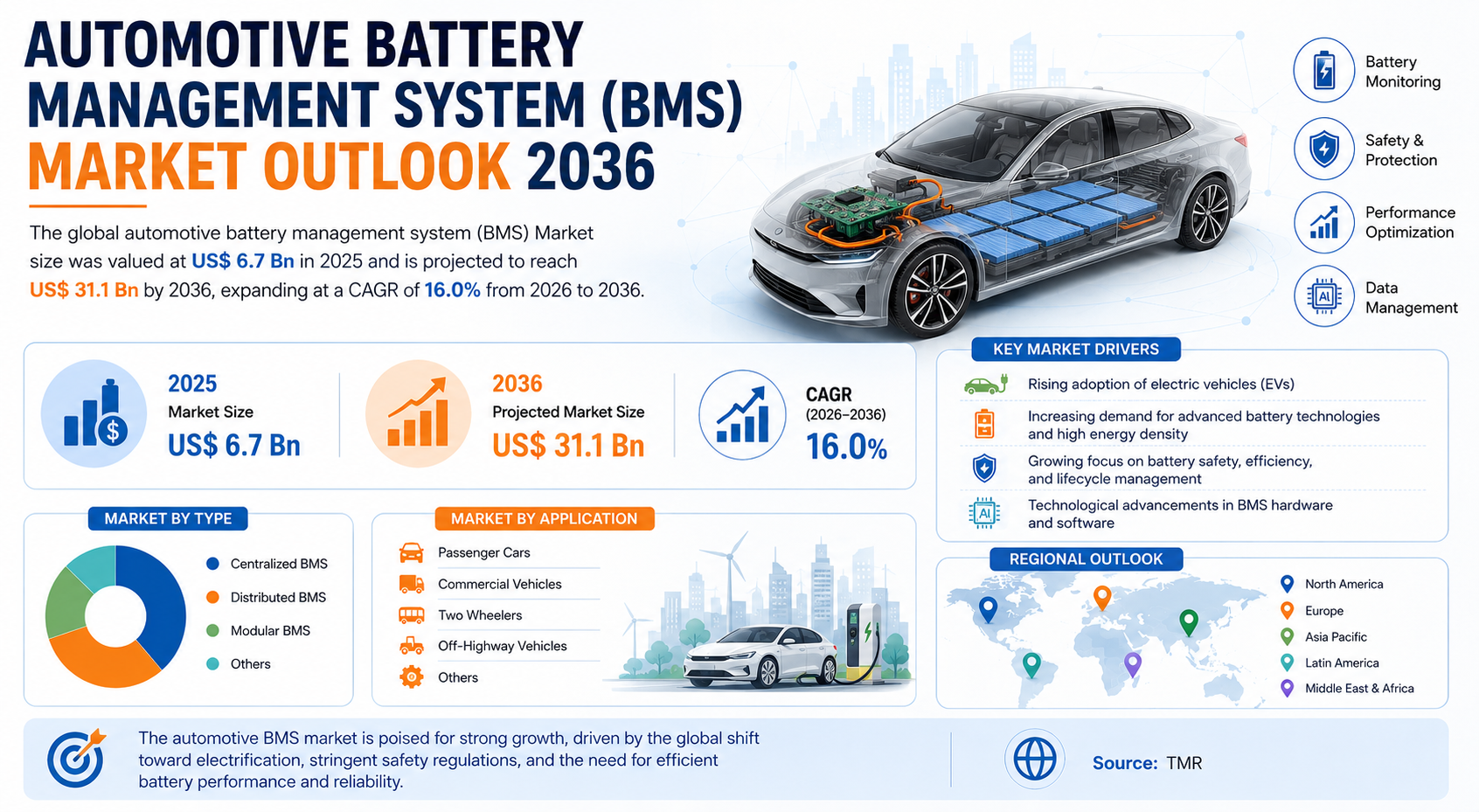
The global Automotive Battery Management System (BMS) Market is poised for substantial growth over the next decade, fueled by the rapid adoption of electric vehicles (EVs), increasing deployment of high-energy-density lithium-ion batteries, and stringent emission regulations across major automotive markets. According to the latest industry analysis, the market was valued at US$ 6.7 Billion in 2025 and is projected to reach US$ 31.1 Billion by 2036, expanding at a CAGR of 16.0% during the forecast period from 2026 to 2036.
Battery Management Systems have become indispensable components in modern electric and hybrid vehicles. These systems ensure optimal battery performance, safety, efficiency, and longevity by continuously monitoring battery voltage, temperature, current flow, and charging status. As vehicle electrification accelerates globally, advanced BMS solutions are becoming critical enablers of next-generation mobility.
Explore pivotal insights and conclusions from our Report in this sample –
https://www.transparencymarketresearch.com/sample/sample.php?flag=S&rep_id=80703
Market Size
The Automotive Battery Management System (BMS) Market has emerged as one of the fastest-growing segments within the automotive electronics industry. The market achieved a valuation of US$ 6.7 Billion in 2025 and is forecast to expand nearly fivefold to reach US$ 31.1 Billion by 2036.
The strong growth trajectory reflects the automotive industry’s ongoing transition from conventional internal combustion engine vehicles toward battery electric vehicles (BEVs), plug-in hybrid electric vehicles (PHEVs), and hybrid electric vehicles (HEVs). Rising investments in battery manufacturing facilities, EV charging infrastructure, and advanced vehicle platforms are expected to further strengthen demand for sophisticated battery management solutions.
The increasing complexity of battery packs, especially in high-voltage vehicle architectures, has transformed BMS technology from a simple monitoring tool into an intelligent software-driven safety platform capable of delivering predictive analytics, thermal optimization, and battery health management.
Market Overview
Automotive Battery Management Systems serve as the intelligence layer between battery cells and vehicle control systems. These systems are designed to maximize battery efficiency while ensuring safe operation under varying environmental and driving conditions.
Modern BMS platforms perform several critical functions including:
- State of Charge (SOC) estimation
- State of Health (SOH) monitoring
- Cell balancing
- Thermal management
- Fault detection and diagnostics
- Overcharge and over-discharge protection
- Communication with vehicle control units
As automotive manufacturers continue to increase battery capacities and operating voltages to achieve longer driving ranges, the role of BMS technology becomes increasingly vital. The market is witnessing a growing shift toward modular and distributed BMS architectures that offer improved scalability, redundancy, and integration flexibility.
Furthermore, cloud-connected BMS solutions are gaining traction as manufacturers seek real-time battery insights, predictive maintenance capabilities, over-the-air software updates, and fleet-level battery analytics.
Key Market Growth Drivers
Rising Adoption of High-Energy-Density Lithium-Ion Batteries
One of the most significant growth drivers for the Automotive BMS Market is the widespread adoption of high-energy-density lithium-ion batteries. These batteries offer superior energy storage, faster charging capabilities, extended lifecycle performance, and improved efficiency compared to conventional battery technologies.
However, lithium-ion batteries require precise monitoring and control due to their sensitivity to temperature fluctuations, overcharging, and cell imbalances. This creates substantial demand for advanced BMS platforms capable of ensuring safe and efficient battery operation.
The growing utilization of lithium-ion chemistries such as Lithium Iron Phosphate (LFP), Nickel Manganese Cobalt (NMC), and Nickel Cobalt Aluminum (NCA) is further increasing the need for chemistry-specific battery management algorithms.
Stringent Emission and Fuel-Efficiency Regulations
Governments worldwide are implementing increasingly stringent carbon emission standards and fuel-efficiency regulations to combat climate change and reduce dependence on fossil fuels.
As automakers strive to comply with these regulations, investments in EV production continue to rise. Since battery systems represent the core power source of electric vehicles, the demand for highly reliable battery management systems has expanded significantly.
BMS solutions play a crucial role in helping manufacturers meet regulatory requirements by optimizing battery utilization, extending battery lifespan, and ensuring vehicle safety.
Expansion of Electric Vehicle Production
Global electric vehicle production continues to grow at an unprecedented pace. Automakers across North America, Europe, and Asia Pacific are launching new EV models while expanding manufacturing capacity.
Every electric vehicle requires sophisticated battery management technology to maximize performance and safety. Consequently, the rapid increase in EV production directly translates into higher demand for advanced BMS systems.
Increasing Focus on Battery Safety
Battery safety remains a top priority for automakers and regulatory agencies. High-voltage battery packs require continuous monitoring to prevent thermal runaway events, overheating, and electrical faults.
Advanced BMS technologies equipped with real-time diagnostics and predictive maintenance capabilities help manufacturers improve battery safety and enhance consumer confidence in electric vehicles.
Analysis of Key Players – Key Player Strategies
The competitive landscape of the Automotive Battery Management System Market is characterized by continuous innovation, strategic collaborations, and extensive research and development activities.
Leading industry participants include Robert Bosch GmbH, LG Energy Solution, Panasonic Corporation, CATL, Samsung SDI, Sensata Technologies, Eberspaecher Vecture Inc., Toshiba Corporation, Nuvation Engineering, AVL LIST GmbH, NXP Semiconductors NV, Lithium Balance A/S, Texas Instruments Inc., and Ficosa Internacional SA.
These companies are focusing on several strategic initiatives to strengthen their market positions:
Product Innovation
Market leaders are investing heavily in next-generation BMS technologies featuring enhanced battery diagnostics, cloud connectivity, cybersecurity protection, and AI-driven predictive analytics.
Strategic Partnerships
Collaborations between battery manufacturers, automotive OEMs, and semiconductor companies are accelerating technology development and reducing commercialization timelines.
Expansion of Product Portfolios
Companies are broadening their offerings to address diverse battery chemistries and vehicle categories, including passenger vehicles, commercial vehicles, and heavy-duty transportation applications.
Focus on Software-Defined Vehicles
With the emergence of software-defined vehicles, industry participants are integrating intelligent BMS platforms capable of supporting over-the-air updates and advanced energy management functions.
Global Manufacturing Expansion
Key players are expanding manufacturing capabilities and establishing regional production facilities to meet increasing demand from automotive OEMs worldwide.
Market Challenges & Opportunities
Challenges
High Development Complexity
Developing advanced BMS solutions requires expertise in battery chemistry, software engineering, electronics, and automotive safety standards. The increasing complexity of battery architectures presents significant design challenges.
Cost Pressures
Automotive manufacturers continuously seek to reduce vehicle production costs while maintaining high safety and performance standards. BMS suppliers must balance innovation with cost efficiency.
Rapid Technology Evolution
The emergence of new battery chemistries and energy storage technologies requires ongoing investments in research and development, creating pressure on technology providers.
Cybersecurity Concerns
As connected and cloud-enabled BMS platforms become more prevalent, cybersecurity risks associated with battery data and vehicle communications are increasing.
Opportunities
Growth of Electric Mobility
The global shift toward electric transportation presents immense opportunities for BMS manufacturers across passenger and commercial vehicle segments.
Advanced Analytics and AI Integration
Artificial intelligence and machine learning technologies offer significant potential for improving battery diagnostics, predictive maintenance, and energy optimization.
Expansion of Commercial EV Fleets
The electrification of logistics, public transportation, and commercial vehicle fleets is creating new demand for high-performance battery management systems.
Emerging Markets
Rapid urbanization and increasing EV adoption in emerging economies are expected to create substantial growth opportunities for BMS providers.
Key Player Strategies
Industry participants are pursuing multiple growth strategies to capitalize on market expansion opportunities:
- Development of intelligent and cloud-connected BMS solutions
- Investment in advanced battery monitoring technologies
- Expansion into emerging EV markets
- Strategic acquisitions and partnerships
- Integration of AI and predictive maintenance features
- Enhancement of battery safety and reliability capabilities
- Focus on scalable modular and distributed BMS architectures
- Strengthening relationships with automotive OEMs and battery manufacturers
These strategic initiatives are expected to shape the competitive dynamics of the market throughout the forecast period.
Recent Developments
- In November 2025, NXP Semiconductors launched the First Battery Management System Chipset with integrated electrochemical impedance spectroscopy for enhanced electric vehicle safety and performance.
- In November 2025, Infineon Technologies launched the PSoC 4 HVPA-SPM 1.0, an automotive-grade microcontroller for high-voltage EV battery management systems (BMS) that brings intelligence, high-precision monitoring (voltage, current, temp), and safety (ASIL D) to the battery edge, supporting zonal architectures and the move to Software-Defined Vehicles (SDVs) to simplify development and improve efficiency.
Investment Landscape and ROI Outlook
The Automotive BMS Market presents a highly attractive investment opportunity due to strong long-term growth fundamentals and increasing EV penetration worldwide.
Investors are increasingly targeting companies involved in battery electronics, semiconductor solutions, software-defined vehicle technologies, and battery analytics platforms. Venture capital firms and institutional investors continue to support startups developing advanced battery intelligence and energy management solutions.
The expected CAGR of 16.0% through 2036 reflects strong revenue generation potential across the value chain. Manufacturers focusing on AI-enabled diagnostics, cloud-connected battery management, and high-voltage applications are expected to achieve particularly favorable returns on investment.
As governments continue supporting EV adoption through incentives, infrastructure investments, and regulatory initiatives, the market’s investment outlook remains highly positive.
Market Segmentations
By Type
- Centralized BMS
- Distributed BMS
- Modular BMS
By Battery
- Lithium-Ion Battery
- Lead-Acid Battery
- Others
By Component
- Battery Monitoring Unit (BMU)
- Control Unit/Microcontroller
- Balancing Circuit
- MOSFET
- Temperature Sensors
- Others
By Propulsion
- Battery Electric Vehicle (BEV)
- Plug-in Hybrid Electric Vehicle (PHEV)
- ICE
By Vehicle Type
- Passenger Vehicle
- Light Commercial Vehicles (LCVs)
- Heavy Commercial Vehicles (HCVs)
By Sales Channel
- OEM
- Aftermarket
By Region
North America
- U.S.
- Canada
Europe
- Germany
- U.K.
- France
- Italy
- Spain
- Switzerland
- The Netherlands
Asia Pacific
- China
- India
- Japan
- South Korea
- Australia & New Zealand
Latin America
- Brazil
- Mexico
- Argentina
Middle East & Africa
- GCC Countries
- South Africa
Why Buy This Report?
- Comprehensive analysis of the global Automotive BMS Market through 2036.
- Detailed market sizing and forecast assessments.
- In-depth evaluation of key market drivers, challenges, and opportunities.
- Competitive benchmarking of leading industry participants.
- Analysis of emerging technology trends and innovation strategies.
- Regional and country-level market insights.
- Detailed segmentation across battery types, vehicle categories, and sales channels.
- Investment opportunity assessment and ROI outlook.
- Strategic recommendations for stakeholders and investors.
- Coverage of recent developments shaping future market dynamics.
Frequently Asked Questions (FAQs)
1. What is the projected size of the Automotive Battery Management System Market by 2036?
The market is expected to reach US$ 31.1 Billion by 2036, growing from US$ 6.7 Billion in 2025.
2. What is driving the growth of the Automotive BMS Market?
Major growth drivers include increasing EV adoption, rising use of lithium-ion batteries, stringent emission regulations, and advancements in battery technology.
3. Which battery segment dominates the market?
The lithium-ion battery segment dominated the market in 2025, accounting for 59% of total revenue.
4. Which region leads the Automotive Battery Management System Market?
Asia Pacific led the global market in 2025 with a 47% revenue share, supported by strong EV production and government incentives.
5. Who are the major players in the Automotive BMS Market?
Key market participants include Robert Bosch GmbH, LG Energy Solution, Panasonic Corporation, CATL, Samsung SDI, Sensata Technologies, AVL LIST GmbH, NXP Semiconductors NV, Texas Instruments Inc., and Ficosa Internacional SA.
About Us Transparency Market Research
Transparency Market Research, a global market research company registered at Wilmington, Delaware, United States, provides custom research and consulting services. The firm scrutinizes factors shaping the dynamics of demand in various markets. The insights and perspectives on the markets evaluate opportunities in various segments. The opportunities in the segments based on source, application, demographics, sales channel, and end-use are analysed, which will determine growth in the markets over the next decade.
Our exclusive blend of quantitative forecasting and trends analysis provides forward-looking insights for thousands of decision-makers, made possible by experienced teams of Analysts, Researchers, and Consultants. The proprietary data sources and various tools & techniques we use always reflect the latest trends and information. With a broad research and analysis capability, Transparency Market Research employs rigorous primary and secondary research techniques in all of its business reports.
Media Contact:
Abhishek Budholiya
Transparency Market Research Inc.
State Tower, 90 State Street, Suite 700,
Albany NY – 12207, United States
Tel: +1-518-618-1030
USA – Canada Toll Free: 866-552-3453
Website: https://www.transparencymarketresearch.com
Media Inquiries: media@transparencymarketresearch.com
Sales Inquiries: sales@transparencymarketresearch.com